In the diagram given below, the triangle represents men, the circle represents…
2023
In the diagram given below, the triangle represents men, the circle represents non-educated people, the square represents sports persons and the rectangle represents married people. How many non-educated married women who are not sports persons are there?
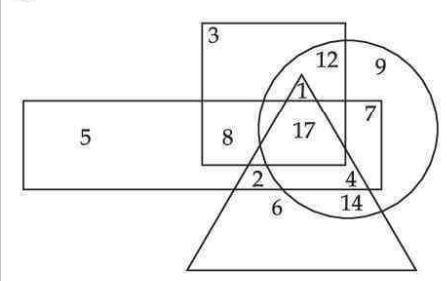
Answer: B. 7 — Concept: In a labelled Venn diagram each shape is assigned one set, and every number printed inside the figure is the count of people in the region where that…
- A.
6
- B.
7
- C.
8
- D.
9
Attempted by 180 students.
Show answer & explanation
Correct answer: B
Concept: In a labelled Venn diagram each shape is assigned one set, and every number printed inside the figure is the count of people in the region where that number sits. A region belongs to a set when it lies inside that shape’s boundary, and is excluded from the set when it lies outside that boundary. When a question names a category that has no shape of its own but is the plain opposite of a category that does — such as “women” against a shape drawn for men — that category is the complement of the drawn set, and so is represented by the entire area outside that shape. A requirement made of several conditions therefore becomes one inside/outside test per shape, and the region that passes every test at the same time carries the required count.
Application: Here the legend fixes triangle = men, circle = non-educated, square = sports persons, rectangle = married. The figure gives no shape of its own to “women”, “educated”, “unmarried” or “not a sports person” — each of these is the plain opposite of a set that is drawn, so each is read as the area outside the matching shape:
woman = not a man = outside the triangle
educated = not non-educated = outside the circle
unmarried = not married = outside the rectangle
not a sports person = outside the square
The question asks for people who are non-educated, married, women, and not sports persons, so the region we want must be inside the circle, inside the rectangle, outside the triangle and outside the square, all at once. Testing the four counts offered (6, 7, 8, 9) against all four conditions together:
Count in the figure | Inside the circle (non-educated)? | Inside the rectangle (married)? | Outside the triangle (a woman)? | Outside the square (not a sports person)? | All four conditions met? |
|---|---|---|---|---|---|
6 | No — it lies outside the circle | No — it lies outside the rectangle | No — it lies inside the triangle, so it counts men | Yes — it lies outside the square | Fails three of the four conditions |
7 | Yes — it lies inside the circle | Yes — it lies inside the rectangle | Yes — it lies outside the triangle | Yes — it lies outside the square | Meets every condition |
8 | No — it lies outside the circle | Yes — it lies inside the rectangle | Yes — it lies outside the triangle | No — it lies inside the square, so it counts sports persons | Fails two of the four conditions |
9 | Yes — it lies inside the circle | No — it lies outside the rectangle | Yes — it lies outside the triangle | Yes — it lies outside the square | Fails one condition, marriage |
Cross-check: Tracing the figure directly confirms this: the count 7 sits in the thin strip where the circle overlaps the wide rectangle, to the right of the triangle’s slanting right edge and beyond the right edge of the square. Every condition is load-bearing — 9 clears three of the four tests and is ruled out only because it lies outside the rectangle, while 6 lies inside the triangle and therefore counts men whatever else is true of it. Only one of the four counts clears all four boundaries at the same time.
Answer: So the number of non-educated married women who are not sports persons is 7.