Look at the following figure and identify the principle of perceptual…
2019
Look at the following figure and identify the principle of perceptual organization proposed by Gestalt.
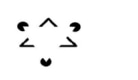
Answer: D. Law of Closure — Concept: Gestalt's Law of Closure states that when a figure has gaps or is incomplete, the visual system automatically fills in the missing parts and…
- A.
Law of Continuity
- B.
Law of Common Fate
- C.
Law of Similarity
- D.
Law of Closure
Attempted by 296 students.
Show answer & explanation
Correct answer: D
Concept: Gestalt's Law of Closure states that when a figure has gaps or is incomplete, the visual system automatically fills in the missing parts and perceives it as a single, complete, closed shape - as long as enough of the outline is present to imply the whole.
Application: The figure here uses three “Pac-Man”-style sectors at the corners along with short angle-bracket lines, but no complete triangle outline is actually drawn. Because these fragments sit exactly where the corners and edges of an equilateral triangle would be, the visual system fills in the missing sides and a solid white triangle with clear (illusory) edges appears to lie on top of the sectors. This mental completion of a fragmented figure into one whole shape is the Law of Closure - the same principle behind the classic Kanizsa triangle illusion.
Why the other Gestalt principles do not fit here:
Law of Continuity — groups elements lying along a smooth, uninterrupted line or curve so the eye follows one continuous path; the sectors and brackets here do not form a single flowing line to trace, so continuity is not the operating principle.
Law of Common Fate — groups elements that move together in the same direction; the figure is completely static, so there is no motion cue for common fate to act on.
Law of Similarity — groups elements that share visual features such as shape or size; the three corner sectors do look alike, but similarity only explains why we might group them, not why we perceive a bounded triangle whose edges are not physically drawn — that specific gap-filling effect is what closure, not similarity, accounts for.
Result: Because the figure is completed into a whole triangle purely by the mind filling in missing contours, the principle illustrated is the Law of Closure.