Select the option in which the given figure is embedded (rotation is NOT…
2026
Select the option in which the given figure is embedded (rotation is NOT allowed)
Attempted by 51 students.
Show answer & explanation
Concept — An embedded-figure item asks where a target drawing survives untouched inside a larger composite. When rotation is barred, the target must reappear at the same orientation, the same scale and the same proportions: every segment of it has to be traceable on the composite, meeting its neighbours at the same points and the same angles. Extra lines crossing or surrounding the target are allowed, because embedding only requires that the target’s own lines are all present. A single segment that leans the other way, or a junction that has slid along a line, destroys the embedding even when the overall shapes look familiar.
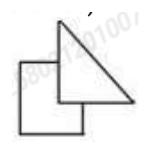
Application — Break the target into the seven segments it is actually built from:
a vertical line — the left leg of a right-angled triangle;
a horizontal line of nearly the same length, running right from the foot of that leg — the base;
a straight line from the top of the leg to the right end of the base, so the slant descends as it goes right;
a horizontal line running left out of the leg, starting about halfway down it;
a vertical line dropping from the left end of segment 4;
a horizontal line running right from the foot of segment 5;
a short vertical line joining the right end of segment 6 back up to the base, meeting it about one-third of the way along from the corner.
Segments 1–3 are the right-angled triangle; segments 4–7 are the rectangle that swallows the triangle’s bottom-left corner and projects to the left of the leg and below the base.
Segment 3 fixes the search. A descending slant of that length can only come from a square cut corner-to-corner by an unbroken line running from its top-left corner to its bottom-right corner — the lower-left half of such a square is precisely the triangle of segments 1–3. A corner line that is interrupted where a circle crosses it cannot supply segment 3 at all, and a corner line that rises as it goes right is the mirror image, which a no-rotation embedding forbids. So the whole question reduces to two checks: does the composite hold a corner-divided square whose line descends, and does a plain rectangle meet that square at its bottom-left corner, cutting the left side near mid-height and dropping its own right edge from the base about a third of the way along, while projecting outward to the left and below?
Cross-check — Compare the four composites on exactly those two features:
Corner-divided square | Direction of its dividing line | Where the rectangle meets it | Target embedded? |
|---|---|---|---|
High in the frame, circle block at the lower left | Descends from top-left to bottom-right | At its bottom-left corner, projecting left and below | Yes — all seven segments trace out |
Low in the frame, circle block at the upper right | Descends from top-left to bottom-right | At its top-left corner, projecting left and above | No — the rectangle sits on the wrong corner, so segments 4–7 cannot be traced |
Low in the frame, circle block at the upper left | Rises from bottom-left to top-right | Across its upper band | No — the dividing line leans the other way, so segment 3 is absent |
High in the frame, circle block at the lower right | Rises from bottom-left to top-right | Across its lower band | No — the dividing line leans the other way, so segment 3 is absent |
So the given figure lies inside the composite whose corner-divided square sits high in the frame with its dividing line descending from top-left to bottom-right and a plain rectangle meeting that square’s bottom-left corner. Measuring against the triangle’s leg confirms the fit: the rectangle’s top edge cuts the leg at about 48% of its height, its left side drops about 0.89 of a leg-length, its base runs about 0.78 of a leg-length, and its right edge stands about 0.36 of a leg-length tall, meeting the triangle’s base about 32% of the way along — the same proportions the target shows.