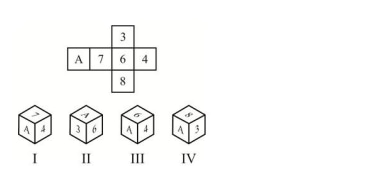
By folding the given paper net, which of the following cubes cannot be made?
20212021
By folding the given paper net, which of the following cubes cannot be made?
Answer: D. I, II, III and IV — ConceptWhen a cube is folded from a net like this one, two faces are opposite (they can never be seen together) when they lie at the two ends of a straight…
- A.
I, II and III
- B.
I, III and IV
- C.
I, II and IV
- D.
I, II, III and IV
Attempted by 127 students.
Show answer & explanation
Correct answer: D
Concept
When a cube is folded from a net like this one, two faces are opposite (they can never be seen together) when they lie at the two ends of a straight line of three squares in the net. So a drawn cube is impossible if any two of its three visible faces are an opposite pair, because opposite faces cannot meet at a corner.
Reading the opposite pairs from the net
The net is a cross. Take each straight strip of three squares; its two end squares are opposite:
Horizontal strip A – 7 – 6 – 4: the squares two apart are opposite, giving A ↔ 6 and 7 ↔ 4.
Vertical strip 3 – 6 – 8: the two ends give 3 ↔ 8.
So the three opposite pairs are A–6, 7–4 and 3–8.
Testing each cube
Read the three faces on each cube and check for any opposite pair:
Cube | Visible faces | Opposite pair shown? | Verdict |
|---|---|---|---|
I | 7, A, 4 | 7 and 4 → opposite | cannot be made |
II | A, 3, 6 | A and 6 → opposite | cannot be made |
III | 6, A, 4 | A and 6 → opposite | cannot be made |
IV | 8, A, 3 | 3 and 8 → opposite | cannot be made |
Cross-check
Cube II's top face is a stylised A, not a 7: its stroke rises to a peak with two legs meeting at a point, matching the A drawn on cube I and cube III's side faces, unlike the single hooked stroke that draws the 7 on cube I's top face. So cube II's three faces are A, 3 and 6, and A–6 is one of the three opposite pairs above — the same kind of clash (a repeated opposite pair among the three visible faces) that already rules out I (which repeats 7–4), III (which repeats A–6) and IV (which repeats 3–8).
Hence the cubes that cannot be made are I, II, III and IV — every one of the four drawn cubes repeats one of the net's three opposite pairs, so none of them can be folded from it.