Match List I with List II: List I List II A. Physical layer I. Transforming…
2023
Match List I with List II:
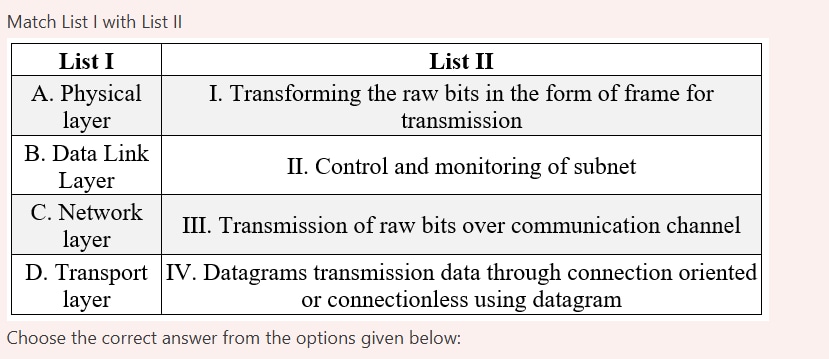
List I | List II |
|---|---|
A. Physical layer | I. Transforming the raw bits in the form of frame for transmission |
B. Data Link Layer | II. Control and monitoring of subnet |
C. Network layer | III. Transmission of raw bits over communication channel |
D. Transport layer | IV. Datagrams transmission through connection oriented or connectionless using datagram |
Choose the correct answer from the options given below:
- A.
(A)-(III), (B)-(II), (C)-(I), (D)-(IV)
- B.
(A)-(II), (B)-(III), (C)-(I), (D)-(IV)
- C.
(A)-(III), (B)-(I), (C)-(II), (D)-(IV)
- D.
(A)-(II), (B)-(IV), (C)-(I), (D)-(III)
Attempted by 1180 students.
Show answer & explanation
Correct answer: C
Concept: The OSI reference model divides network communication into layers, each with one well-defined responsibility. The physical layer moves raw bits, the data link layer frames those bits for reliable single-link delivery, the network layer controls routing across the subnet, and the transport layer provides the end-to-end (connection-oriented or connectionless) delivery service.
Application:
Layer | Correct function | Why |
|---|---|---|
A. Physical layer | III. Transmission of raw bits over communication channel | The physical layer's sole job is moving a raw, unstructured stream of bits across the physical medium -- no framing, addressing, or error control yet. |
B. Data Link Layer | I. Transforming the raw bits in the form of frame for transmission | The data link layer organizes the data into frames and adds error detection before handing the resulting bit stream down to the physical layer for transmission, and reassembles frames from the incoming bit stream on receipt -- providing reliable delivery over a single link. |
C. Network layer | II. Control and monitoring of subnet | The network layer manages routing and traffic control across the subnet -- path selection and congestion control -- directing packets from source to destination across multiple links. |
D. Transport layer | IV. Datagrams transmission through connection oriented or connectionless using datagram | The transport layer provides the end-to-end delivery service to the layer above it, offering either a connection-oriented or a connectionless mode of delivery between hosts -- matching this List II item's description of the transport layer's choice of service. |
Cross-check: Every other offered combination breaks at least one of these unique layer-function pairings -- for example, swapping the physical and network layer's functions, or assigning framing to the transport layer instead of the data link layer, contradicts the OSI model's layer boundaries. Since each List II item is the defining responsibility of exactly one OSI layer, only one combination can pair every layer with its own function.
✅ Final Answer:
A–III, B–I, C–II, D–IV
A video solution is available for this question — log in and enroll to watch it.