Consider the circuit below and determine the output function f(x, y, z).
2012
Consider the circuit below and determine the output function f(x, y, z).
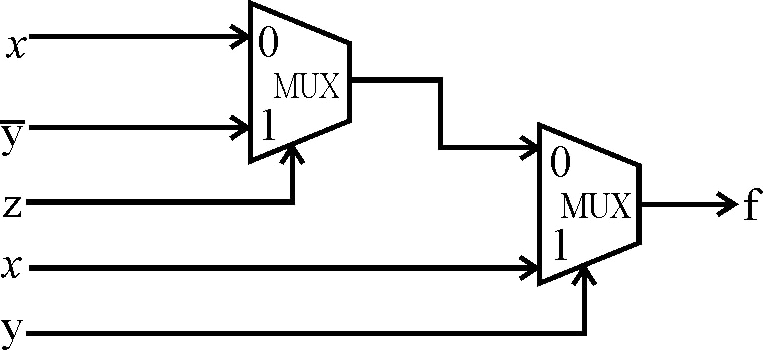
Answer: A. \(x\bar{z} + xy + \bar{y}z\) — ConceptA 2-to-1 multiplexer passes exactly one of its two data inputs through to the output: it forwards I0 while the select line s is 0 and forwards I1 while…
- A.
\(x\bar{z} + xy + \bar{y}z\)
- B.
\(x\bar{z} + xy + \bar{y}\bar{z}\)
- C.
\(xz + xy + \bar{y}\bar{z}\)
- D.
\(xz + x\bar{y} + \bar{y}z\)
Attempted by 21 students.
Show answer & explanation
Correct answer: A
Concept
A 2-to-1 multiplexer passes exactly one of its two data inputs through to the output: it forwards I0 while the select line s is 0 and forwards I1 while s is 1, which in Boolean form is \(I_0\bar{s}+I_1s\). When multiplexers are cascaded, handle one stage at a time — write the earlier stage's output as an intermediate expression, substitute that expression into the data input of the next stage, and then simplify.
Application
Let a be the output of the first multiplexer. With I0 = x, I1 = \(\bar{y}\), and s = z, \(a=x\bar{z}+\bar{y}z\).
For the second multiplexer, I0 = a, I1 = x, and s = y. Therefore \(f=a\bar{y}+xy\).
Substituting a gives \(f=(x\bar{z}+\bar{y}z)\bar{y}+xy=x\bar{y}\bar{z}+\bar{y}z+xy\).
Using \(y+\bar{y}\bar{z}=y+\bar{z}\), simplify to \(f=x\bar{z}+xy+\bar{y}z\).
Cross-check
When y = 1, the second multiplexer selects x, and the simplified expression becomes x. When y = 0, the circuit gives \(x\bar{z}+z=x+z\), which is also obtained from the simplified expression.
Hence \(f(x,y,z)=x\bar{z}+xy+\bar{y}z\).