Consider the following formation tree for a propositional formula, where…
2009
Consider the following formation tree for a propositional formula, where \(\land\) denotes AND, \(\lor\) denotes OR, and \(\neg\) denotes NOT:
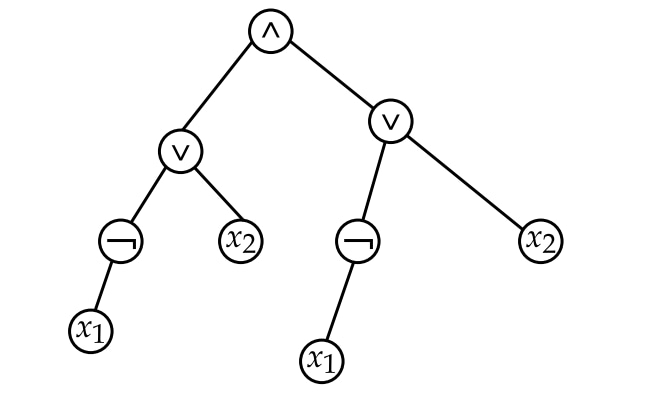
The propositional formula represented by this tree is:
Answer: C. \((\neg x_1 \lor x_2) \land (\neg x_1 \lor x_2)\) — A formation (parse) tree for a propositional formula is built from the leaves upward: each leaf is a propositional variable, a node with exactly one child…
- A.
\((x_2 \lor \neg x_1) \land (x_1 \lor \neg x_1)\)
- B.
\((x_2 \lor \neg x_2) \land (x_1 \lor x_2)\)
- C.
\((\neg x_1 \lor x_2) \land (\neg x_1 \lor x_2)\)
- D.
None of these
Attempted by 29 students.
Show answer & explanation
Correct answer: C
A formation (parse) tree for a propositional formula is built from the leaves upward: each leaf is a propositional variable, a node with exactly one child applies a unary connective such as \(\neg\) (NOT) to that child's subformula, and a node with two children applies a binary connective such as \(\land\) (AND) or \(\lor\) (OR) to its left and right subformulas. The formula for the whole tree is obtained by combining subformulas from the leaves up to the root.
The left child of the root is a \(\lor\) node; its own children are a \(\neg\) node over the leaf \(x_1\) and a separate leaf \(x_2\), so this subtree gives \((\neg x_1 \lor x_2)\).
The right child of the root has the identical shape — a \(\lor\) node over a \(\neg\) node on \(x_1\) and a leaf \(x_2\) — so this subtree also gives \((\neg x_1 \lor x_2)\).
The root itself is a \(\land\) node joining these two subtrees, so the tree as a whole represents \((\neg x_1 \lor x_2) \land (\neg x_1 \lor x_2)\).
This reading can be cross-checked independently against the tree's own shape: the tree has exactly one root conjunction, exactly two disjunction nodes, exactly two occurrences of a negated \(x_1\) leaf, and exactly two occurrences of an unnegated \(x_2\) leaf — and the derived expression \((\neg x_1 \lor x_2) \land (\neg x_1 \lor x_2)\) has exactly this connective inventory (one \(\land\), two \(\lor\), two negated \(x_1\)'s, two \(x_2\)'s), confirming the tree was traversed correctly. Separately, because both operands of the root \(\land\) are the same subformula \((\neg x_1 \lor x_2)\), the idempotent law \(P \land P \equiv P\) shows this is logically equivalent to the single disjunction \(\neg x_1 \lor x_2\). This derived expression matches one of the listed propositional formulas exactly, character for character.