Match the LIST-I with LIST-II Choose the correct answer from the options given…
2026
Match the LIST-I with LIST-II
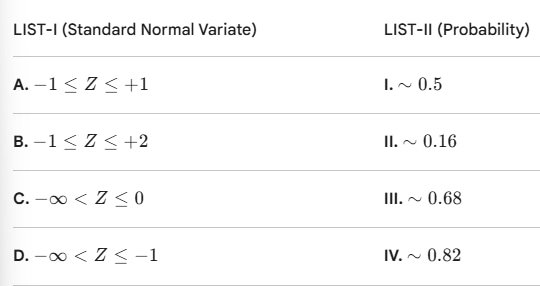
Choose the correct answer from the options given below:
- A.
A-I, B-II, C-III, D-IV
- B.
A-II, B-III, C-IV, D-I
- C.
A-III, B-IV, C-I, D-II
- D.
A-III, B-II, C-I, D-IV
Show answer & explanation
Correct answer: C
For a standard normal variate Z, the probability that Z falls within a given range equals the area under the standard normal curve between the range's bounds, given by the cumulative distribution function Φ(z) = P(Z ≤ z). Symmetry about the mean (Z = 0) gives two direct facts: Φ(0) = 0.5 exactly, and for any a > 0 the two tails beyond +a and beyond −a are equal, so the two-sided band −a ≤ Z ≤ a has probability 1 − 2·P(Z ≤ −a). The empirical (68–95–99.7) rule adds the standard benchmark that about 68% of a normal distribution lies within one standard deviation of the mean.
A (−1 ≤ Z ≤ +1): the classic ±1 standard-deviation band around the mean. By the empirical rule this covers approximately 68% of the distribution.
B (−1 ≤ Z ≤ +2): splitting the band at the mean, the piece from −1 to 0 covers about 0.34 and the piece from 0 to +2 covers about 0.48; adding them gives approximately 0.82.
C (−∞ < Z ≤ 0): exactly the lower half of the distribution by symmetry about the mean, so the probability is exactly 0.5 — no table lookup needed.
D (−∞ < Z ≤ −1): the lower tail beyond one standard deviation below the mean. Since the ±1 SD band (A) covers about 68%, the two symmetric excluded tails together cover the remaining 32%, so one tail alone — D — covers half of that, about 0.16.
Two internal-consistency checks confirm these values: containment — B's range fully contains A's range (it extends further on the upper side), so B's probability (≈0.82) must exceed A's (≈0.68), which it does; and C's range fully contains D's range, so C's probability (0.5) must exceed D's (≈0.16), which it does. Symmetry gives a second check: A's probability plus twice D's probability must equal 1, since the two-sided band plus its two equal excluded tails covers the whole distribution — 0.68 + 2(0.16) = 1.00, confirming consistency.
List-I range | Computed probability | List-II match |
|---|---|---|
A (−1 ≤ Z ≤ +1) | ≈ 0.68 | III |
B (−1 ≤ Z ≤ +2) | ≈ 0.82 | IV |
C (−∞ < Z ≤ 0) | 0.5 (exact) | I |
D (−∞ < Z ≤ −1) | ≈ 0.16 | II |
So the complete match is A–III, B–IV, C–I, D–II.