Consider the following transportation problem : The initial basic feasible…
2015
Consider the following transportation problem :
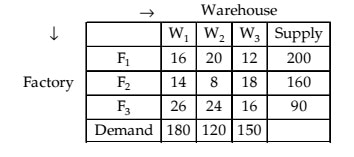
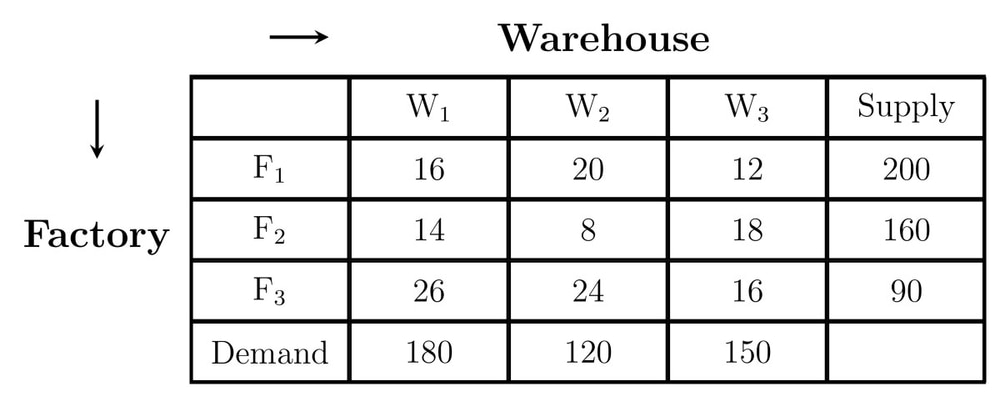
The initial basic feasible solution of the above transportation problem using Vogel's Approximation method (VAM) is given below :
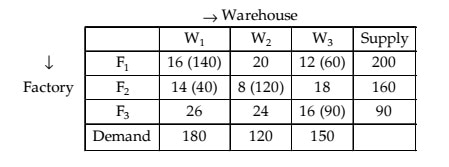
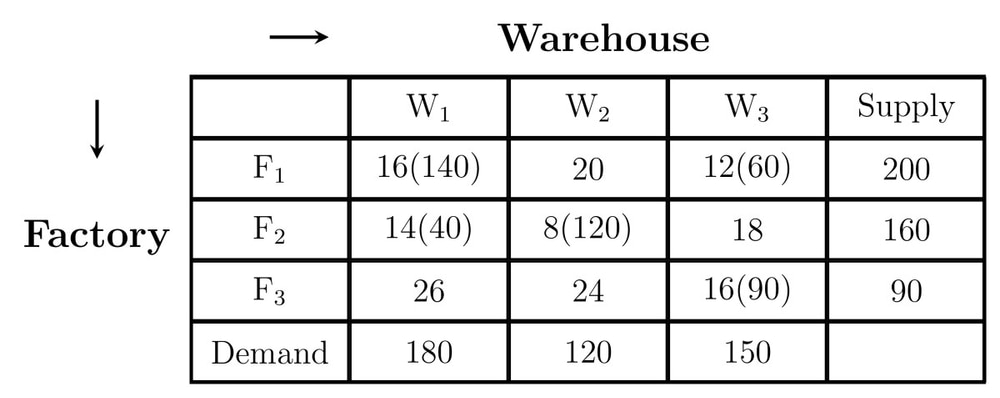
The solution of the above problem :
- A.
is degenerate solution
- B.
is optimum solution
- C.
needs to improve
- D.
is infeasible solution
Attempted by 3 students.
Show answer & explanation
Correct answer: B
Given initial allocations (from VAM): F1→W1 = 140, F1→W3 = 60, F2→W1 = 40, F2→W2 = 120, F3→W3 = 90. These satisfy supplies and demands (each factory supply and warehouse demand matches).
Step 1 - Check non-degeneracy: number of basic cells = 5 which equals m + n - 1 = 5, so the solution is non-degenerate.
Step 2 - Compute u-v potentials (MODI): set u(F1) = 0.
From basic cells:
u(F1) + v(W1) = 16 ⇒ v(W1) = 16
u(F1) + v(W3) = 12 ⇒ v(W3) = 12
u(F2) + v(W1) = 14 ⇒ u(F2) = 14 − 16 = −2
u(F2) + v(W2) = 8 ⇒ v(W2) = 8 − (−2) = 10
u(F3) + v(W3) = 16 ⇒ u(F3) = 16 − 12 = 4
Step 3 - Compute reduced costs for non-basic cells c_ij − (u_i + v_j):
For F1→W2: 20 − (0 + 10) = 10 ≥ 0
For F2→W3: 18 − (−2 + 12) = 8 ≥ 0
For F3→W1: 26 − (4 + 16) = 6 ≥ 0
For F3→W2: 24 − (4 + 10) = 10 ≥ 0
All reduced costs are nonnegative, so the current solution satisfies optimality conditions for a minimization problem.
Step 4 - Compute total transportation cost:
Cost = 140×16 + 60×12 + 40×14 + 120×8 + 90×16 = 2240 + 720 + 560 + 960 + 1440 = 5920
Conclusion: The given initial basic feasible solution is optimal with minimum total transportation cost = 5920.