Consider the following transportation problem: The transportation cost in the…
2015
Consider the following transportation problem:
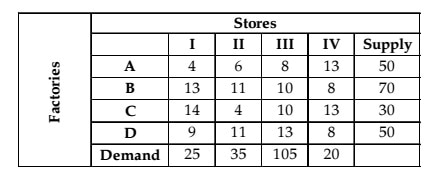
The transportation cost in the initial basic feasible solution of the above transportation problem using Vogel's Approximation method is :
- A.
1450
- B.
1465
- C.
1480
- D.
1520
Attempted by 5 students.
Show answer & explanation
Correct answer: B
Solution (Vogel's Approximation Method):
Step 1 — Balance the problem:
Total supply = 50 + 70 + 30 + 50 = 200; total demand = 25 + 35 + 105 + 20 = 185.
Add a dummy demand of 15 with zero cost to balance supplies and demands.
Step 2 — Apply Vogel's method (key choices shown):
Initial penalties lead to allocating the dummy demand (15) to factory D (cost 0).
Allocate factory C → Store II: 30 units at cost 4 (C supply exhausted).
Allocate factory A → Store I: 25 units at cost 4 (demand I satisfied).
Allocate factory A → Store II: 5 units at cost 6 (demand II now 0, A remaining 20).
Allocate factory A → Store III: 20 units at cost 8 (A exhausted).
Remaining demands: Store III needs 85, Store IV needs 20. Remaining supplies: B = 70, D = 35.
Allocate factory D → Store IV: 20 units at cost 8 (D now has 15 left).
Allocate factory B → Store III: 70 units at cost 10 (B exhausted).
Allocate remaining factory D → Store III: 15 units at cost 13 (D exhausted).
Step 3 — Summarize allocations and costs:
Factory D → dummy demand: 15 units × 0 = 0
Factory C → Store II: 30 × 4 = 120
Factory A → Store I: 25 × 4 = 100
Factory A → Store II: 5 × 6 = 30
Factory A → Store III: 20 × 8 = 160
Factory D → Store IV: 20 × 8 = 160
Factory B → Store III: 70 × 10 = 700
Factory D → Store III: 15 × 13 = 195
Total transportation cost = 0 + 120 + 100 + 30 + 160 + 160 + 700 + 195 = 1465
Note: Different tie-breaking in VAM can produce other initial feasible allocations (with different initial costs). The sequence above (allocating the dummy demand to factory D) yields the initial solution with cost 1465, which matches the correct answer.