The following transportation problem : has a solution The above solution of a…
2016
The following transportation problem :
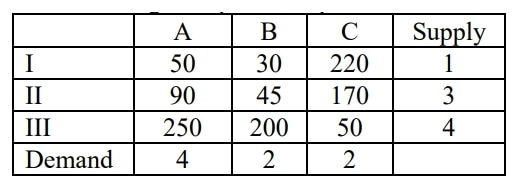
has a solution
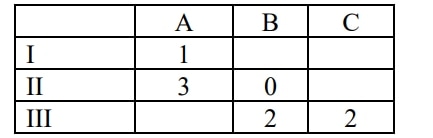
The above solution of a given transportation problem is
- A.
infeasible solution
- B.
optimum solution
- C.
non-optimum solution
- D.
unbounded solution
Attempted by 11 students.
Show answer & explanation
Correct answer: B
Check: Verify optimality using the MODI (u-v) method.
Occupied (basic) cells and allocations: I→A = 1, II→A = 3, II→B = 0 (basic zero), III→B = 2, III→C = 2.
Set potential u for row I = 0. Compute potentials from occupied cells: v_A = 50; u_II = 90 - v_A = 40; v_B = 45 - u_II = 5; u_III = 200 - v_B = 195; v_C = 50 - u_III = -145.
Compute reduced costs (cost - (u + v)) for non-basic cells:
I→B: 30 - (0 + 5) = 25
I→C: 220 - (0 + -145) = 365
II→C: 170 - (40 + -145) = 275
III→A: 250 - (195 + 50) = 5
All reduced costs are nonnegative, so no improvement is possible for this minimization problem.
Conclusion: The given allocation is an optimum solution.