Consider the tree given below. Using the property of eccentricity of a vertex,…
2012
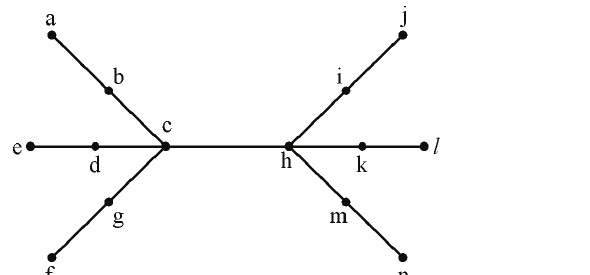
Consider the tree given below. Using the property of eccentricity of a vertex, find every vertex that is the centre of the given tree.
Answer: D. c & h — ConceptIn a connected graph the eccentricity e(v) of a vertex v is its greatest distance to any other vertex, e(v) = max d(v, u) taken over all vertices u.…
- A.
d & h
- B.
c & k
- C.
g, b, c, h, i, m
- D.
c & h
Attempted by 32 students.
Show answer & explanation
Correct answer: D
Concept
In a connected graph the eccentricity e(v) of a vertex v is its greatest distance to any other vertex, e(v) = max d(v, u) taken over all vertices u. The radius of the graph is the smallest eccentricity that occurs anywhere in it, and the centre is the set of all vertices whose eccentricity equals that radius.
For a tree this set is always either a single vertex or a pair of adjacent vertices, and it sits at the midpoint of any longest path, so the centre can be found either by computing eccentricities or by bisecting a longest path.
Applying it to this tree
Read the edges: a–b, b–c, c–d, d–e, c–g, g–f, c–h, h–i, i–j, h–k, k–l, h–m, m–n. Vertex c carries the three branches c–b–a, c–d–e and c–g–f; vertex h carries the three branches h–i–j, h–k–l and h–m–n; the single edge c–h joins the two halves.
Eccentricity of c: the vertices farthest from c are j, l and n, each reached in three edges (c–h–i–j, c–h–k–l, c–h–m–n), so e(c) = 3.
Eccentricity of h: by the mirror-image structure the vertices farthest from h are a, e and f, each reached in three edges (h–c–b–a, h–c–d–e, h–c–g–f), so e(h) = 3.
Eccentricity of a vertex one edge outside a junction, say b: the farthest vertices are j, l and n at b–c–h–i–j, four edges away, so e(b) = 4. The same count gives e(d) = e(g) = 4 on the left half and e(i) = e(k) = e(m) = 4 on the right half.
Eccentricity of a leaf, say a: the farthest vertices are j, l and n at a–b–c–h–i–j, five edges away, so e(a) = 5, and likewise e(e) = e(f) = e(j) = e(l) = e(n) = 5.
The smallest eccentricity occurring anywhere in the tree is therefore 3, so the radius is 3, and the vertices attaining it are exactly c and h.
Vertices | Eccentricity |
|---|---|
c, h | 3 |
b, d, g, i, k, m | 4 |
a, e, f, j, l, n | 5 |
Cross-check
A longest path runs from a leaf of one half to a leaf of the other, for example a–b–c–h–i–j, which has five edges, so the diameter of the tree is 5. A path of five edges has its midpoint on the middle edge, and that edge is c–h; bisecting a longest path therefore returns the same pair of adjacent vertices, with radius equal to the ceiling of 5/2, that is 3.
Conclusion
The centre of this tree is the pair of adjacent vertices c and h, both of eccentricity 3.