The function represented by the k-map given below is
2010
The function represented by the k-map given below is
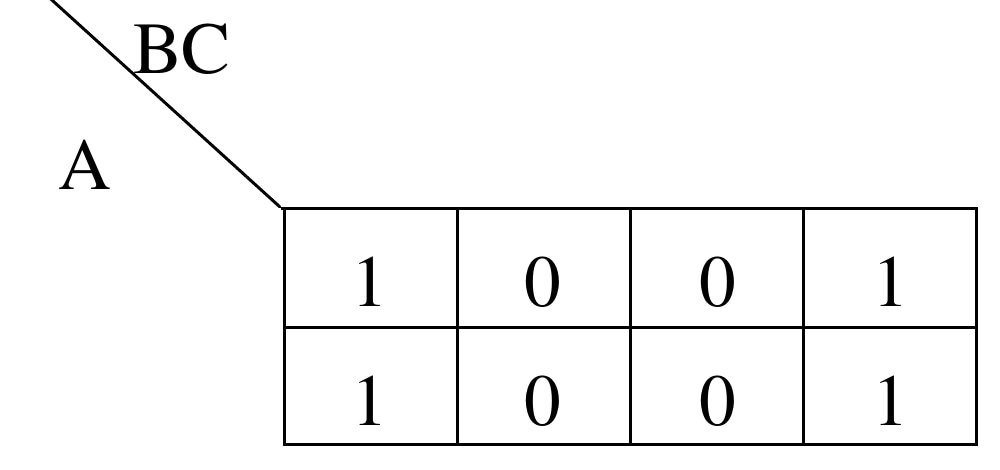
Answer: C. \(\overline{B \oplus C}\) — Concept — A Karnaugh map is a truth table laid out in a grid: each cell stands for one minterm, and the function it represents is the OR of the minterms whose…
- A.
\(A \cdot B\)
- B.
\(AB + BC + CA\)
- C.
\(\overline{B \oplus C}\)
- D.
\(A \cdot B \cdot C\)
Attempted by 24 students.
Show answer & explanation
Correct answer: C
Concept — A Karnaugh map is a truth table laid out in a grid: each cell stands for one minterm, and the function it represents is the OR of the minterms whose cells are marked 1. The columns are normally listed in Gray-code order 00, 01, 11, 10 so that neighbouring cells differ in a single variable, which is what makes visual grouping work. Independently of any ordering, if the two halves of the map belonging to one variable carry identical patterns then the output never changes when that variable changes, so that variable drops out and what survives is a function of the remaining variables only.
The map, with the source paper's column order restored
The printed figure carries only the corner words BC and A; the numeric row values and column values are not shown on it. The cell entries below are exactly what the figure gives, 1, 0, 0, 1 in each of the two rows, while the labels are restored from the source paper's own convention, which step 3 explains.
A (row) / BC (col) | 00 | 01 | 10 | 11 |
|---|---|---|---|---|
0 | 1 | 0 | 0 | 1 |
1 | 1 | 0 | 0 | 1 |
Application
Compare the two rows of the map. The upper row reads 1, 0, 0, 1 and the lower row reads 1, 0, 0, 1 as well, so the two rows are identical cell for cell.
Identical rows mean the output is the same for A = 0 and for A = 1 at every (B, C) pair, so the function does not depend on A at all and A cannot appear in the answer. Of the four expressions offered, exactly one is free of A, so this single observation already decides the choice without needing any column labels.
The column order still matters for writing the expression itself, and it has to be taken from the source rather than guessed. Under the usual Gray-code order BC = 00, 01, 11, 10 the two marked columns would be BC = 00 and BC = 10, giving \(\overline{C}\), which is not among the choices at all. This paper, like the identical earlier GATE 1998 item built on the same figure, writes the BC columns in plain binary order 00, 01, 10, 11, so the two marked columns are BC = 00 and BC = 11. Note the trade-off this creates: plain binary order places 01 next to 10, and those differ in both variables, so neighbouring cells here are no longer single-variable neighbours and the grouping has to be read off the minterm values rather than off visual adjacency.
BC = 00 and BC = 11 are exactly the two combinations in which B and C carry the same value, so the sum-of-products form of the map is \(\overline{B}\cdot\overline{C} + B \cdot C\).
\(\overline{B}\cdot\overline{C} + B \cdot C\) is the standard equivalence (XNOR) identity, that is, the complement of the exclusive-OR: \(\overline{B \oplus C}\).
Cross-check
Expand \(\overline{B \oplus C}\) over all eight (A, B, C) rows: its value is 1 on (0, 0, 0), (0, 1, 1), (1, 0, 0) and (1, 1, 1) — four cells, two in each row of the map, which is precisely the four 1s drawn above.
\(A \cdot B\) has value 1 on only two of the eight combinations and both of them lie in the A = 1 row, so a map of it could not show identical rows.
\(AB + BC + CA\) also has value 1 on four combinations, but they are the four in which at least two of A, B, C are 1, and those split one to the A = 0 row and three to the A = 1 row rather than two and two.
\(A \cdot B \cdot C\) has value 1 on a single combination, far fewer than the four 1s shown on the map.
The two routes agree. Step 2 on its own, where only one offered expression is free of A, and the minterm reading in steps 3 to 5 both land on the same expression, so the choice does not rest on the column-order convention alone.
Hence the function represented by the map is \(\overline{B \oplus C}\), the equivalence (XNOR) of B and C.