Match List I (Typical Aristotelian syllogism) with List II (Technical names in…
2020
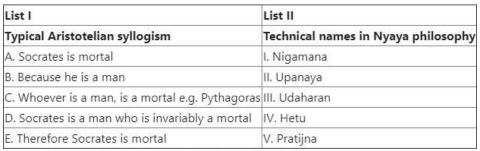
Match List I (Typical Aristotelian syllogism) with List II (Technical names in Nyaya philosophy) and select the correct answer from the options given below:
Answer: A. A - V, B - IV, C - III, D - II, E - I — ConceptIn Nyaya philosophy a complete inference (anumana) for debate is set out in a fixed five-membered syllogism, the pancha-avayava. Its members always…
- A.
A - V, B - IV, C - III, D - II, E - I
- B.
A - I, B - II, C - III, D - IV, E - V
- C.
A - III, B - I, C - II, D - V, E - IV
- D.
A - II, B - III, C - I, D - IV, E - V
Show answer & explanation
Correct answer: A
Concept
In Nyaya philosophy a complete inference (anumana) for debate is set out in a fixed five-membered syllogism, the pancha-avayava. Its members always occur in this order: Pratijna (the proposition or thesis to be proved), Hetu (the reason), Udaharana (the universal rule stated with a confirming example), Upanaya (application of that universal rule to the present case), and Nigamana (the conclusion that restates the thesis as now proved).
Application
Reading the Aristotelian statements in the order A to E and matching each to the Nyaya member by the logical job it performs:
Aristotelian statement | Role it performs | Nyaya member |
|---|---|---|
Socrates is mortal | bare thesis set down to be proved | Pratijna (V) |
Because he is a man | the reason offered | Hetu (IV) |
Whoever is a man is mortal, e.g. Pythagoras | universal rule with a supporting example | Udaharana (III) |
Socrates is a man who is invariably mortal | the universal rule applied to this case | Upanaya (II) |
Therefore Socrates is mortal | conclusion restating the thesis as proved | Nigamana (I) |
This gives the match A - V, B - IV, C - III, D - II, E - I.
Cross-check
Two structural markers confirm the order. The first statement is a bare assertion with no inferential word, which is exactly the Pratijna that opens every Nyaya syllogism. The last statement begins with "Therefore", the hallmark of the closing Nigamana. Since the proposition must come first and the conclusion last, A maps to Pratijna and E maps to Nigamana, with Hetu, Udaharana and Upanaya filling the three middle steps in their fixed sequence.