Match List I with List II : Choose the correct answer from the options given…
2020
Match List I with List II :
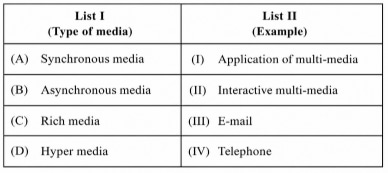
Choose the correct answer from the options given below :
- A.
(A)-(I), (B)-(II), (C)-(III), (D)-(IV)
- B.
(A)-(IV), (B)-(III), (C)-(II), (D)-(I)
- C.
(A)-(II), (B)-(IV), (C)-(I), (D)-(III)
- D.
(A)-(III), (B)-(I), (C)-(IV), (D)-(II)
Show answer & explanation
Correct answer: B
Concept
Media are classified along two axes: TIMING and STRUCTURE. On timing, synchronous media needs the sender and receiver present at the same instant, as in a live two-way exchange, while asynchronous media allows a gap between sending and receiving. On structure, rich media blends multiple modes such as text, audio, video, and animation to create an engaging, interactive experience, while hyper media extends this further into a linked, navigable multimedia application.
Application
Synchronous media needs real-time, simultaneous presence of both parties — the telephone is the standard example, since a call requires both sides to talk and listen at the same moment.
Asynchronous media does not need simultaneous presence — e-mail is written and read at different times, the defining asynchronous case.
Rich media is about an engaging, two-way multimedia experience — interactive multi-media names exactly this interactive richness.
Hyper media is a linked, navigable multimedia structure built as an application — an application of multi-media describes exactly such a built, structured multimedia product.
So the matching is: Synchronous media – the telephone, Asynchronous media – e-mail, Rich media – interactive multi-media, Hyper media – an application of multi-media.
Cross-check
The pairing that links Synchronous media to an application of multi-media and Asynchronous media to interactive multi-media swaps the timing-based examples with the structure-based ones, so the real-time telephone and the delayed e-mail end up matched to the wrong media types.
The pairing that links Synchronous media to interactive multi-media and Asynchronous media to the telephone reverses the timing logic entirely, since the telephone needs simultaneous presence and interactive multi-media does not test that timing property.
The pairing that links Synchronous media to e-mail treats the textbook asynchronous example as synchronous, and it also swaps rich media and hyper media's structure-based examples with each other.