Match List I with List II
2020
Match List I with List II
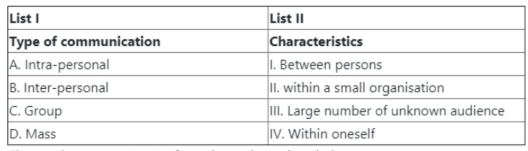
Answer: D. A - IV, B - I, C - II, D - III — Concept: communication is classified by the level at which it operates — by how many people share the message and how far the source can identify them. Each…
- A.
A - I, B - II, C - III, D - IV
- B.
A - II, B - III, C - IV, D - I
- C.
A - III, B - IV, C - I, D - II
- D.
A - IV, B - I, C - II, D - III
Show answer & explanation
Correct answer: D
Concept: communication is classified by the level at which it operates — by how many people share the message and how far the source can identify them. Each step outward, from a single mind to another individual, then to a bounded collective, then to an anonymous public, defines a distinct level of communication.
Application: apply that ladder to each type listed in List I.
Intra-personal communication takes place inside one individual — thinking, self-talk, internal reflection — so the sender and the receiver are the same person; its characteristic is within oneself, which is IV.
Inter-personal communication takes place between two identified individuals exchanging messages directly, with immediate feedback; its characteristic is between persons, which is I.
Group communication takes place among the members of a small bounded collective such as a team, a committee or a small organisation, where every participant is still known to the others; its characteristic is within a small organisation, which is II.
Mass communication carries a message through a medium to a large, scattered and heterogeneous audience that the source cannot identify; its characteristic is a large number of unknown audience, which is III.
Cross-check: the audience widens strictly as you move down List I — one person, two persons, a small known collective, an unknown public — and the four characteristics line up one-to-one with that widening.
Type of communication | Who is involved | Matching characteristic |
|---|---|---|
Intra-personal | One person; sender and receiver are the same | IV. Within oneself |
Inter-personal | Two identified persons in direct exchange | I. Between persons |
Group | A small bounded collective whose members are known | II. Within a small organisation |
Mass | A large scattered audience the source cannot identify | III. Large number of unknown audience |
Contrast: treating between persons as intra-personal ignores that intra-personal communication has only one participant, and treating within oneself as mass ignores that mass communication is defined by an audience the source cannot identify; the two ends of the ladder cannot be swapped.
Result: A - IV, B - I, C - II, D - III.