Match List I with List II : Choose the correct answer from the options given…
2020
Match List I with List II :
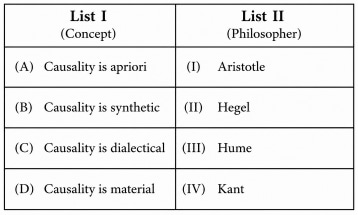
Choose the correct answer from the options given below :
- A.
(A)-(II), (B)-(I), (C)-(IV), (D)-(III)
- B.
(A)-(IV), (B)-(III), (C)-(II), (D)-(I)
- C.
(A)-(I), (B)-(IV), (C)-(III), (D)-(II)
- D.
(A)-(III), (B)-(I), (C)-(II), (D)-(IV)
Show answer & explanation
Correct answer: B
Concept: Different philosophers characterize causality differently. Kant holds causality is an a priori category of the understanding (known independent of experience); Hume holds causal connections are established synthetically, through experience and habitual observation, not by pure reason alone; Hegel situates causality within his dialectical logic, where cause and effect are moments of a single developing process; Aristotle's theory of causation rests on his doctrine of the four causes, one of which is the material cause, tying causality to the matter a thing is made of.
Application: Matching each concept in List I to the philosopher in List II who holds that view:
"Causality is apriori" is Kant's position — for Kant, causality is a pure concept of the understanding applied to experience, not derived from it.
"Causality is synthetic" is Hume's position — Hume treats the cause-effect link as a matter-of-fact (synthetic) claim grounded in repeated experience, not a truth of reason.
"Causality is dialectical" is Hegel's position — Hegel folds causality into his dialectical account of how concepts and reality develop through contradiction and resolution.
"Causality is material" is Aristotle's position — his four-causes framework grounds causal explanation in the material cause, the matter out of which a thing is made.
Cross-check: Cross-checking each near-miss re-pairing against the philosophers' actual positions rules it out:
Assigning the a priori view to Hume would contradict Hume's empiricism — he explicitly denies causality can be known independent of experience.
Assigning the dialectical view to Kant would contradict Kant’s account of causality as an a priori category of the understanding, not a moment of dialectical development.
Assigning the material-cause view to Hegel would contradict his dialectical account of causality, which is not grounded in matter/substance.
Result: Causality is apriori → Kant; Causality is synthetic → Hume; Causality is dialectical → Hegel; Causality is material → Aristotle.