Find the missing number from the given alternatives – For clarity, the wedge…
2022
Find the missing number from the given alternatives –
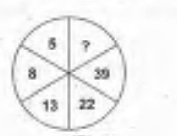
For clarity, the wedge values shown in the image are also listed here by position:
Position | Value |
|---|---|
Top-left | 5 |
Top-right | ? (missing) |
Right | 39 |
Bottom-right | 22 |
Bottom-left | 13 |
Left | 8 |
Answer: C. 72 — Concept: In a number-wheel (or number-series) reasoning puzzle, the values are not random: they're linked by a single arithmetic rule connecting each term to…
- A.
66
- B.
71
- C.
72
- D.
78
Attempted by 146 students.
Show answer & explanation
Correct answer: C
Concept: In a number-wheel (or number-series) reasoning puzzle, the values are not random: they're linked by a single arithmetic rule connecting each term to the next. To find a missing term, read the values in a consistent order, take the differences between consecutive terms, and check whether those differences themselves follow a simple secondary rule (constant, common ratio, or a recurrence like ‘double and adjust’). That secondary rule then predicts the next difference — and hence the missing value.
Application: Reading the wedge values in order — 5, 8, 13, 22, 39, ? — gives the sequence to analyse.
Find the differences between consecutive terms: 8 − 5 = 3; 13 − 8 = 5; 22 − 13 = 9; 39 − 22 = 17.
Compare each difference with the one before it: 2 × 3 − 1 = 5; 2 × 5 − 1 = 9; 2 × 9 − 1 = 17 — each difference equals twice the previous difference minus one.
Apply the same rule to get the next difference: 2 × 17 − 1 = 33.
Add this to the last known term: 39 + 33 = 72.
Cross-check: Look at the differences of the differences: 5 − 3 = 2; 9 − 5 = 4; 17 − 9 = 8 — these double at each step, so the next one is 16, confirming the next first-difference is 17 + 16 = 33 by an independent route, and 39 + 33 = 72 again.
So the missing number is 72.