Directions: Read the information and answer the following question. Four…
2023
Directions: Read the information and answer the following question.
Four stations are arranged in a rectangle ABCDA. The distance from A to B is (P2+100) km and the distance from B to C is (20P+100) km. Train Y starts from station A and travels to D via B and C. The total distance travelled by the train is 2700 km in 25 hours. The table below shows each train's time to cross a pole and time to cross a platform.
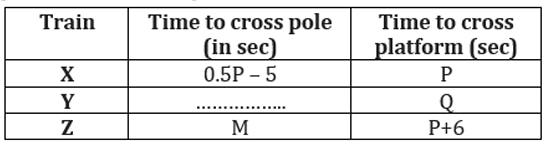
Note: The average time taken by all the trains to cross the platform is (Q+6) seconds and the length of the platform = 400 metres.
If the length of Train Z is the average length of Train X and Train Y, then find M (Train Z's time to cross a pole, in seconds).
Answer: A. 14 — ConceptFor a train of length L moving at constant speed v, crossing a pole (a point) covers only its own length, so time = L / v. Crossing a platform of…
- A.
14
- B.
32.14
- C.
28
- D.
20
- E.
21
Attempted by 9 students.
Show answer & explanation
Correct answer: A
Concept
For a train of length L moving at constant speed v, crossing a pole (a point) covers only its own length, so time = L / v. Crossing a platform of length p covers length (L + p), so time = (L + p) / v. From these two facts, v = L / tpole = (L + p) / tplatform. Average speed = total distance / total time also gives a train's speed directly.
Application
Find P from the journey. ABCDA is a rectangle, so AB = CD and BC = DA. Train Y goes A → B → C → D, covering AB + BC + CD = 2·AB + BC. So 2(P2+100) + (20P+100) = 2700 → 2P2 + 20P + 300 = 2700 → P2 + 10P − 1200 = 0 → (P−30)(P+40) = 0 → P = 30 (reject −40).
Length of Train X. Pole time = 0.5P − 5 = 10 s; platform time = P = 30 s. Equal speed gives LX/10 = (LX + 400)/30 → 30·LX = 10·LX + 4000 → LX = 200 m.
Find Q, then Train Y. Average platform time = (P + Q + (P+6))/3 = Q + 6 → 2P + 6 = 2Q + 12 → Q = P − 6 = 24 s. Train Y's speed = total distance / total time = 2700 km / 25 h = 108 km/h = 30 m/s. Its platform time is Q = 24 s, so LY + 400 = 30 × 24 = 720 → LY = 320 m.
Length of Train Z. LZ = average of LX and LY = (200 + 320)/2 = 260 m.
Find M (Z's pole time). Z's platform time = P + 6 = 36 s, so Z's speed = (260 + 400)/36 = 660/36 = 18.33 m/s. Then M = LZ/speed = 260 / 18.33 = 36 × 260 / 660 ≈ 14.18 s.
Cross-check
M = 14.18 s rounds to 14, the only value near it among the choices (32.14, 28, 20, 21 are all far off). Re-deriving via the compact identity M = (platform time of Z) × LZ / (LZ + 400) = 36 × 260 / 660 = 14.18 s confirms the result. Hence M ≈ 14.