In the given figure, O is the centre of the circle and if ∠OAC = 30°, the…
2019
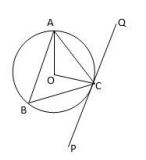
In the given figure, O is the centre of the circle and if ∠OAC = 30°, the acute angle between AC and the tangent PQ at C is:
Answer: A. 60° — Concept: The tangent–chord (alternate-segment) theorem: the angle between a tangent at a point and a chord drawn from that point equals the angle the chord…
- A.
60°
- B.
45°
- C.
90°
- D.
30°
Attempted by 80 students.
Show answer & explanation
Correct answer: A
Concept: The tangent–chord (alternate-segment) theorem: the angle between a tangent at a point and a chord drawn from that point equals the angle the chord subtends in the alternate segment. Equivalently, since the radius to the point of tangency is perpendicular to the tangent there, the tangent–chord angle equals 90° minus the angle between that chord and the radius.
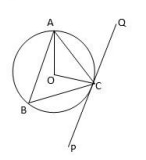
OA and OC are both radii of the same circle, so OA = OC and triangle OAC is isosceles; its base angles at A and C are therefore equal, so ∠OCA = ∠OAC.
Since ∠OAC = 30°, ∠OCA is also 30°.
The tangent PQ touches the circle at C, so PQ is perpendicular to OC, making the angle between PQ and OC equal to 90°.
Chord CA lies between the radius OC and the tangent PQ at C, so the angle between CA and PQ is the remaining part of that right angle: 90° − 30° = 60°.
Cross-check: In triangle OAC, ∠AOC = 180° − 30° − 30° = 120°. By the inscribed-angle theorem, any angle subtended by chord AC from the major arc equals half of ∠AOC, i.e. 60°; the alternate-segment theorem equates the tangent-chord angle at C to this inscribed angle, again giving 60° — consistent with the first method.
So the acute angle between AC and the tangent PQ at C is 60°.
A video solution is available for this question — log in and enroll to watch it.