In the following figure, ABCD is a parallelogram. AE ⟂ DC and CF ⟂ AD. If AB =…
2019
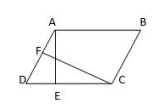
In the following figure, ABCD is a parallelogram. AE ⟂ DC and CF ⟂ AD. If AB = 16 cm, AE = 8 cm and CF = 10 cm, then AD is:
Answer: A. 12.8 cm — Concept: in a parallelogram, Area = base × height stays the same no matter which pair of parallel sides is chosen as the base and its perpendicular height.…
- A.
12.8 cm
- B.
8 cm
- C.
10 cm
- D.
16 cm
Attempted by 79 students.
Show answer & explanation
Correct answer: A
Concept: in a parallelogram, Area = base × height stays the same no matter which pair of parallel sides is chosen as the base and its perpendicular height.
Applying it here:
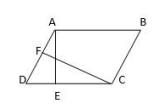
Take AB as the base (AB = 16 cm). Its corresponding height is AE = 8 cm, the perpendicular distance between AB and DC. So Area = AB × AE = 16 × 8 = 128 cm².
Now take AD as the base instead. Its corresponding height is CF = 10 cm, the perpendicular distance between AD and BC. So Area = AD × CF = AD × 10.
Both expressions equal the same area of the parallelogram, so AD × 10 = 128, which gives AD = 128 ÷ 10 = 12.8 cm.
Cross-check with similar triangles: right triangle ADE (right angle at E, since AE ⟂ DC) and right triangle CDF (right angle at F, since CF ⟂ AD) share the same angle at D — both angle ADE and angle CDF are the parallelogram's angle ADC. With a right angle and the angle at D equal, triangle ADE ~ triangle CDF (AA similarity), matching A ↔ C, D ↔ D, and E ↔ F.
This similarity gives AD/CD = AE/CF. Since CD = AB = 16 cm (opposite sides of a parallelogram are equal), AD/16 = 8/10, so AD = 16 × 8 ÷ 10 = 12.8 cm — the same result as the area method.
AD = 12.8 cm.
A video solution is available for this question — log in and enroll to watch it.