Directions : Given Pie Chart shows the number of total voters registered from…
2019
Directions : Given Pie Chart shows the number of total voters registered from 4 different villages and all registered voters from these four villages cast their votes.
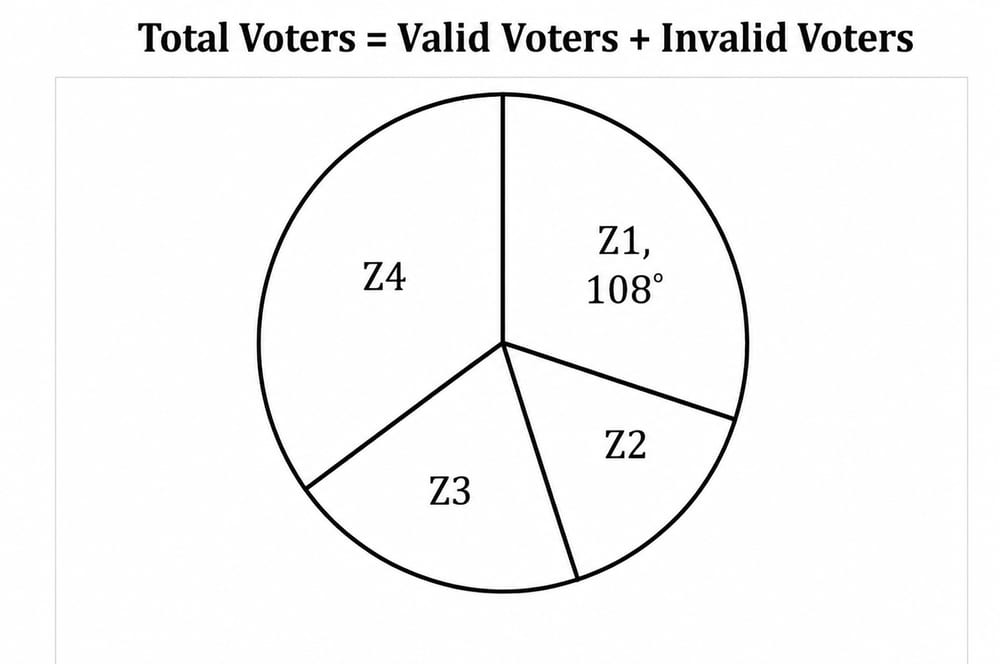
(i) Total number of valid voters in village Z3 is one-third more than the difference of that of from village Z1 & Z2.
(ii) Difference of valid voters from village Z4 and Z2 is 480. Ratio of total voters from village Z2 and that of Z4 is 3 : 7 respectively.
(iii) Total voters in village Z3 are more than that of Z2. Total invalid voters from all the villages together are 20% of total registered voters from all the villages.
What is the central angle corresponding to total voters in village Z2?
Answer: B. 54˚ — Concept: In a pie chart each sector's share of the whole equals its central angle out of 360°, so an angle of θ° represents a fraction θ/360 of the total.…
- A.
72˚
- B.
54˚
- C.
60˚
- D.
75˚
- E.
66˚
Attempted by 7 students.
Show answer & explanation
Correct answer: B
Concept:
In a pie chart each sector's share of the whole equals its central angle out of 360°, so an angle of θ° represents a fraction θ/360 of the total. When two quantities are given as a ratio (a : b) and a fixed absolute difference between them is known, the ratio fixes the unit value: difference = (b − a) units, so one unit = difference / (b − a). In this standard data-interpretation set every village's valid voters are taken as the same proportion of its total (80%, since invalid voters are 20% of the whole), so ratios of totals carry over to valid voters — this is the working assumption these sets use to make the difference of valid voters usable against the total-voter ratio.
Application — find the totals:
Z1's sector is 108°, so Z1 = 108/360 = 30% of all registered voters. Let the total registered voters be T.
Total voters in Z2 : Z4 = 3 : 7, so write total Z2 = 3x and total Z4 = 7x.
Taking valid voters as 80% of each village's total, valid Z4 − valid Z2 = 0.8(7x) − 0.8(3x) = 0.8·4x = 3.2x. Setting this equal to the given 480 gives x = 150.
Hence total Z2 = 3·150 = 450 and total Z4 = 7·150 = 1050.
Apply condition (i): valid Z3 = one-third more than (valid Z1 − valid Z2) = (4/3)·0.8·(0.30T − 450). Since valid Z3 = 0.8·Z3 and Z3 = 0.70T − (Z2 + Z4) = 0.70T − 1500, substitute and solve: 0.40T − 600 = 0.70T − 1500, so 0.30T = 900 and T = 3000.
Central angle of Z2 = (Z2 / T)·360 = (450 / 3000)·360 = 54°.
Cross-check:
With T = 3000 the four sectors are Z1 = 900 (108°), Z2 = 450 (54°), Z3 = 600 (72°), Z4 = 1050 (126°); these angles total exactly 360°, Z3 = 600 > Z2 = 450 (condition iii holds), and valid Z3 = 0.8·600 = 480 = (4/3)·0.8·(900 − 450), so condition (i) is satisfied. Every condition is consistent, confirming 54°.