Directions : Read the following pie charts carefully and answer the questions…
2022
Directions : Read the following pie charts carefully and answer the questions given below.
Pie charts (i) shows percentage distribution of runs scored by three (P, Q & R) different batsmen in a match and pie chart (ii) shows percentage distribution of balls faced by each batsman in a match.
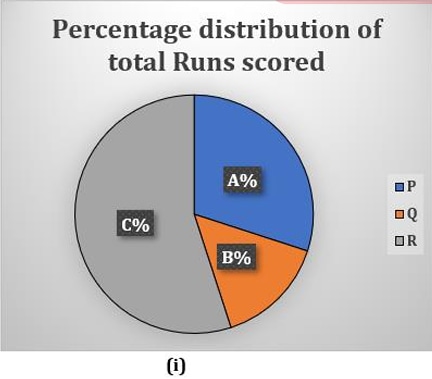
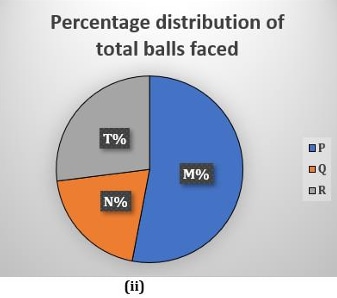
Note: (I) Strike rate of P is 25.
(II) Balls faced by Q is 180 and his strike rate is 33 ⅓.
(III) Had P faced the same number of balls Q faced, but scored same number of runs as he scored initially, then his strike rate would have been double that of Q.
(IV) Balls faced by R is half of the balls faced by P.
(V) Strike rate = (Total runs scored / Total balls faced) × 100.
(VI) Central angle of runs scored by R is 198°.
If P played as many balls as Q plays and Q plays as many balls as R played, then which of the following statement/s is/are correct?
(i) If Q plays 160 balls more, than he will hit a century.
(ii) The strike rate of P is greater than that of R.
(iii) Current strike rate of Q is equal to the previous strike rate of P.
Answer: D. Both i & iii — ConceptStrike Rate (SR) = (Runs / Balls) × 100, so Runs = SR × Balls / 100; once any two of the three are fixed the third follows. A batsman's runs share is…
- A.
Only iii
- B.
Both ii & iii
- C.
Only ii
- D.
Both i & iii
- E.
Both i & ii
Attempted by 10 students.
Show answer & explanation
Correct answer: D
Concept
Strike Rate (SR) = (Runs / Balls) × 100, so Runs = SR × Balls / 100; once any two of the three are fixed the third follows. A batsman's runs share is read from the central angle: share = (central angle / 360°). A player's intrinsic SR is the rate at which he scores, so projecting his runs over a different number of balls uses that intrinsic SR; an SR recomputed after artificially freezing his run total is instead just a derived ratio for that frozen total.
Fix the base data (runs and balls of P, Q, R)
Q: balls = 180, SR = 33⅓ → Runs_Q = 180 × (100/3) ÷ 100 = 60.
Note (III): if P faced 180 balls with his own runs, his SR would be double Q's = 66⅔, so Runs_P = 180 × (200/3) ÷ 100 = 120.
P's actual SR = 25 → Balls_P = 120 × 100 / 25 = 480.
Note (IV): Balls_R = ½ × 480 = 240.
Note (VI): R's runs share = 198° / 360° = 55%, so P and Q are 45% = 180 runs, total = 180 / 0.45 = 400, and Runs_R = 55% × 400 = 220.
Base data: Runs (P, Q, R) = (120, 60, 220); Balls (P, Q, R) = (480, 180, 240). Intrinsic SR: P = 25, Q = 33⅓, R = 91⅔.
Apply the hypothetical
“P plays as many balls as Q plays, and Q plays as many balls as R played”: now P faces 180 balls and Q faces 240 balls, while each batsman keeps his own runs (P = 120, Q = 60).
Test each statement
(i) After the swap Q is facing 240 balls; “160 balls more” means 240 + 160 = 400 balls. By the standard reading, extra deliveries are scored at the batsman's own strike rate, so Q's projected runs use SR = 33⅓: 400 × (100/3) ÷ 100 = 133⅓ runs — past 100, a century. True.
(ii) After the swap, P's SR = 120 / 180 × 100 = 66⅔, while R's SR = 220 / 240 × 100 = 91⅔. Since 66⅔ < 91⅔, P's rate is not greater than R's. False.
(iii) After the swap Q's SR on his 60 runs over 240 balls = 60 / 240 × 100 = 25, and P's previous SR = 120 / 480 × 100 = 25, so they coincide. True.
Cross-check / Result
Statement (i) projects Q's extra balls at his batting rate 33⅓ (the rate at which he scores, not the 25 that only describes his frozen run total), and it clears 100; (iii) matches Q's post-swap ratio to P's original 25; (ii) fails because R's 91⅔ beats P's 66⅔. So the statements that hold are (i) and (iii).