Directions: Read the pie chart carefully and answer the following question.…
2023
Directions: Read the pie chart carefully and answer the following question.
The pie chart shows the percentage distribution of questions attempted by four students (A, B, C and D) in an exam. The exam contains three subjects English, History and Mathematics, which consist of 120, 60 and 100 questions respectively.
The maximum number of questions a student can attempt is 240, and the total number of questions attempted by all the students together is 800.
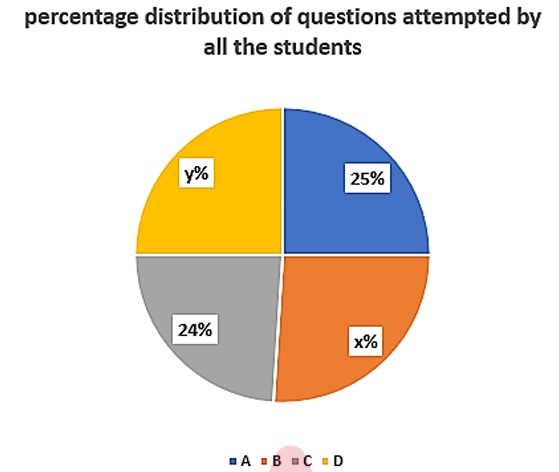
From which of the given statement(s) can we find the exact value of (x – y)?
I: If B attempted the highest number of questions and D attempted the lowest number of questions.
II: If B attempted more than 200 questions, then D attempted less than 190 questions.
Answer: C. Neither (I) nor (II) — ConceptA statement lets us find an exact value only if, together with the given data, it forces that value to be a single unique number. From the pie chart A…
- A.
Only (I)
- B.
Only (II)
- C.
Neither (I) nor (II)
- D.
Either (I) or (II)
- E.
Both (I) and (II) together
Attempted by 11 students.
Show answer & explanation
Correct answer: C
Concept
A statement lets us find an exact value only if, together with the given data, it forces that value to be a single unique number. From the pie chart A = 25% and C = 24%, and the four shares sum to 100%, so x + y = 51. Since all students together attempted 800 questions, each 1% equals 8 questions, so B = 8x and D = 8y. The 240-per-student cap gives 8x ≤ 240 and 8y ≤ 240, so x ≤ 30 and y ≤ 30; with x + y = 51 this forces 21 ≤ x ≤ 30 and 21 ≤ y ≤ 30. The fixed counts are A = 200 and C = 192. (x and y are taken as whole-number percentages throughout, consistent with A = 25% and C = 24% already being whole numbers — the standard convention for this chart type. Even without that assumption the ranges below are open intervals rather than single points, so the same 'not unique' conclusion follows either way.)
Application
Statement I (B highest, D lowest): B highest means 8x > 200, so x > 25; D lowest means 8y < 192, so y < 24, i.e. x > 27 (since x + y = 51). Combined with the cap x ≤ 30, this gives the open interval 27 < x ≤ 30 — infinitely many values even before assuming whole percentages. Restricting to whole-number percentages, x = 28, 29 or 30 (with y = 23, 22 or 21 respectively), giving x − y = 5, 7 or 9. Either way, more than one value remains possible, so Statement I alone does not fix a unique value of (x − y).
Statement II ("if B > 200, then D < 190"): read as a strict logical conditional (a given true fact about the chart), it is automatically satisfied whenever x ≤ 25 (antecedent false, so vacuously true regardless of D) — already an interval of values with no unique x − y — and it fails only in a narrow band just above 25, holding again once x is large enough that D < 190 too. On whole-number percentages this means it holds for x ∈ {21, 22, 23, 24, 25, 28, 29, 30}, giving x − y anywhere in {−9, −7, −5, −3, −1, 5, 7, 9} — eight different values. Read instead as directly asserting both facts — B > 200 (x > 25) and D < 190 (y ≤ 23) — the two conditions combine (with x + y = 51) to the narrower range x ∈ {28, 29, 30}, the same three values as Statement I, giving x − y ∈ {5, 7, 9}. Under either reading, Statement II leaves more than one possible value, so it alone is not sufficient.
Combining I and II: Statement I already narrows things to x ∈ {28, 29, 30}; intersecting this with either reading of Statement II still leaves the same three values, so using both together still leaves three possible values of (x − y) rather than one.
Cross-check
In every case A = 200 and C = 192 are fixed, and only B and D vary along x + y = 51 with 21 ≤ x, y ≤ 30 (from the 240-question cap). The three whole-number pairs consistent with 'B highest, D lowest' — (28,23), (29,22), (30,21) — give x − y = 5, 7 and 9 respectively, and even in the general (non-integer) case the bound is an open interval, not a single point — so no single statement (or their combination) pins one exact value. The value of (x − y) cannot be determined from either statement alone or together — Neither (I) nor (II).