The line graph given below shows the total number of TV sold and difference…
2025
The line graph given below shows the total number of TV sold and difference between cell phone and TV sold by five different shops (A, B, C, D and E).
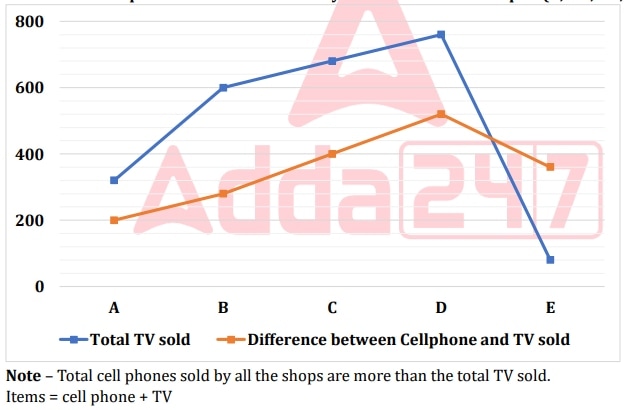
Total items sold by Shop F is 20% more than that by shop C and the ratio of total TV sold and cell phone sold by shop F is 7:15. Find the number of TV sold by F.
- A.
685
- B.
620
- C.
672
- D.
670
- E.
666
Attempted by 1 students.
Show answer & explanation
Correct answer: C
Concept
In this line graph the orange line plots Difference = (Cell phones − TV) for each shop, and the note states cell phones exceed TVs, so for any shop Cell phones = TV + Difference. Therefore Total items of a shop = Cell phones + TV = (TV + Difference) + TV = 2 × TV + Difference. A part-ratio a : b splits a known total into (a + b) equal parts, so each quantity = (its own parts ÷ total parts) × total.
Application
Read Shop C off the graph: TV = 680 and Difference = 400.
Total items sold by Shop C = 2 × TV + Difference = 2 × 680 + 400 = 1760.
Shop F sells 20% more items than C, so Total items of F = 1760 × 1.20 = 2112.
For Shop F the TV : Cell phone ratio is 7 : 15, giving 7 + 15 = 22 equal parts.
TV sold by F = (7 ÷ 22) × 2112 = 7 × 96 = 672.
Cross-check
With TV = 672 the cell-phone share is (15 ÷ 22) × 2112 = 1440, and 672 + 1440 = 2112, which equals Shop F's total — so the split is consistent and 672 holds.