Directions : Given graph shows the number of orders received and cancelled on…
2019
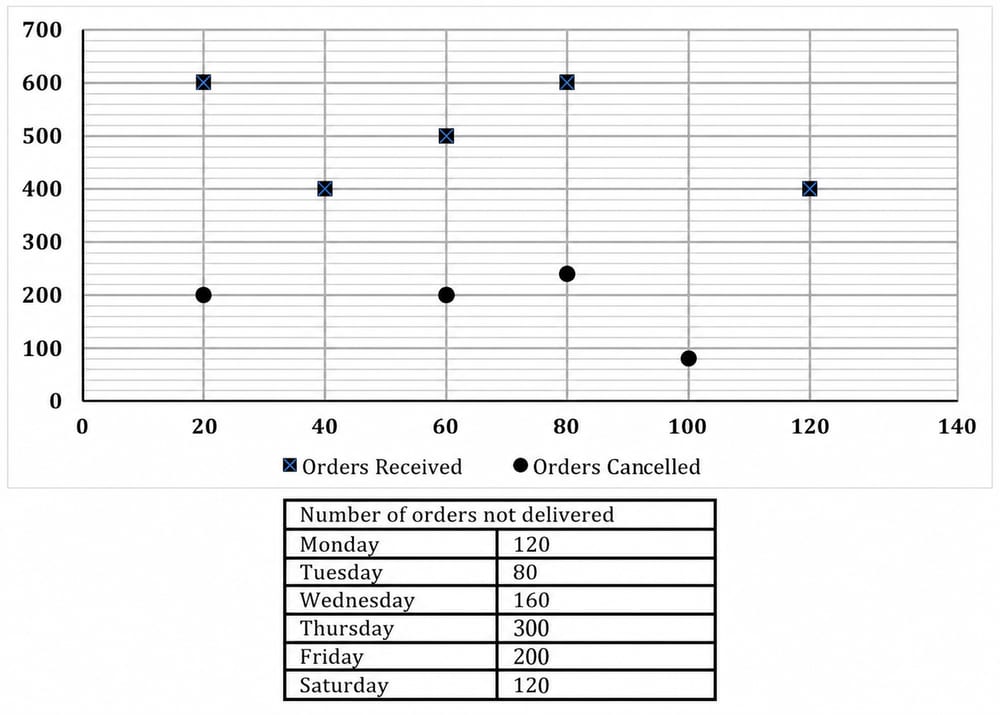
Directions : Given graph shows the number of orders received and cancelled on particular days of a week (From Monday to Saturday) while the table shows the number of orders which were not delivered. Read the data carefully and answer the questions.
(NOTE: Refer Y-Axis values as number of orders while X-Axis values as Days i.e. 20 = Monday, 40 = Tuesday and so on)
(Orders continued/booked are those which are not cancelled)
Some data is missing in the given graph.
Orders Booked = Orders Received – Orders Cancelled
Orders Delivered = Orders Booked – Orders not delivered
if total orders received on last 3 days are 150 more than total orders received on first 3 days and orders delivered on Friday are more than that on Saturday then what can be the difference between orders cancelled on Saturday and orders delivered on Thursday? (Z > 60)
A. 28 B. 49 C. 23 D. 40 E. 17 F. 37
Answer: D. all of these — ConceptIn a missing-data interpretation set, fix every unknown using the stated relations before judging a "what can be" question. Two chains govern this set:…
- A.
A, C, E
- B.
A, C, F
- C.
B, D, F
- D.
all of these
- E.
A, C, D, E, F
Attempted by 1 students.
Show answer & explanation
Correct answer: D
Concept
In a missing-data interpretation set, fix every unknown using the stated relations before judging a "what can be" question. Two chains govern this set: Orders Booked = Received − Cancelled, and Orders Delivered = Booked − Not-delivered. A "what can be" answer is the set of ALL target values that some legal value of the free variable can produce, where "legal" means every derived quantity (booked, delivered) stays non-negative and every stated inequality holds.
Reading the data
From the graph (20=Mon … 120=Sat). Received: Mon 600, Tue 400, Wed 500, Thu 600, Fri missing, Sat 400. Cancelled: Mon 200, Tue missing, Wed 200, Thu 240, Fri 80, Sat missing. Not-delivered (table): Mon 120, Tue 80, Wed 160, Thu 300, Fri 200, Sat 120.
Application
First-3-days (Mon+Tue+Wed) received = 600 + 400 + 500 = 1500.
Last-3-days received must exceed that by 150, so Thu+Fri+Sat received = 1650.
Thu and Sat received are 600 and 400, so Friday received = 1650 − (600 + 400) = 650.
Thursday delivered = (Received − Cancelled) − Not-delivered = (600 − 240) − 300 = 60.
Let Z = Saturday cancelled (the only unknown that matters here). Saturday delivered = (400 − Z) − 120 = 280 − Z.
Friday delivered = (650 − 80) − 200 = 370; the condition ‘Friday delivered > Saturday delivered’ means 370 > 280 − Z, which holds for every Z > −90 — so it never restricts Z.
Physical limits: Saturday booked 400 − Z ≥ 0 and Saturday delivered 280 − Z ≥ 0 give Z ≤ 280; the stem adds Z > 60. Hence 60 < Z ≤ 280.
Target difference = (Saturday cancelled) − (Thursday delivered) = Z − 60. As Z ranges over (60, 280], this difference ranges over (0, 220].
Cross-check — each listed value
Every candidate difference d corresponds to Z = 60 + d, and each such Z lies inside the legal band (60, 280]:
Candidate difference (d) | Z = d + 60 | Saturday booked = 400 - Z | Saturday delivered = 280 - Z | Status |
|---|---|---|---|---|
28 | 88 | 312 | 192 | valid |
49 | 109 | 291 | 171 | valid |
23 | 83 | 317 | 197 | valid |
40 | 100 | 300 | 180 | valid |
17 | 77 | 323 | 203 | valid |
37 | 97 | 303 | 183 | valid |
Since each of the listed candidate differences (28, 49, 23, 40, 17, 37) is individually achievable, no single subset of them can be the answer — the only choice consistent with every candidate passing the test is the one that admits them all.