Direction : Read the data carefully and answer the questions. Note: (i) Market…
2021
Direction : Read the data carefully and answer the questions.
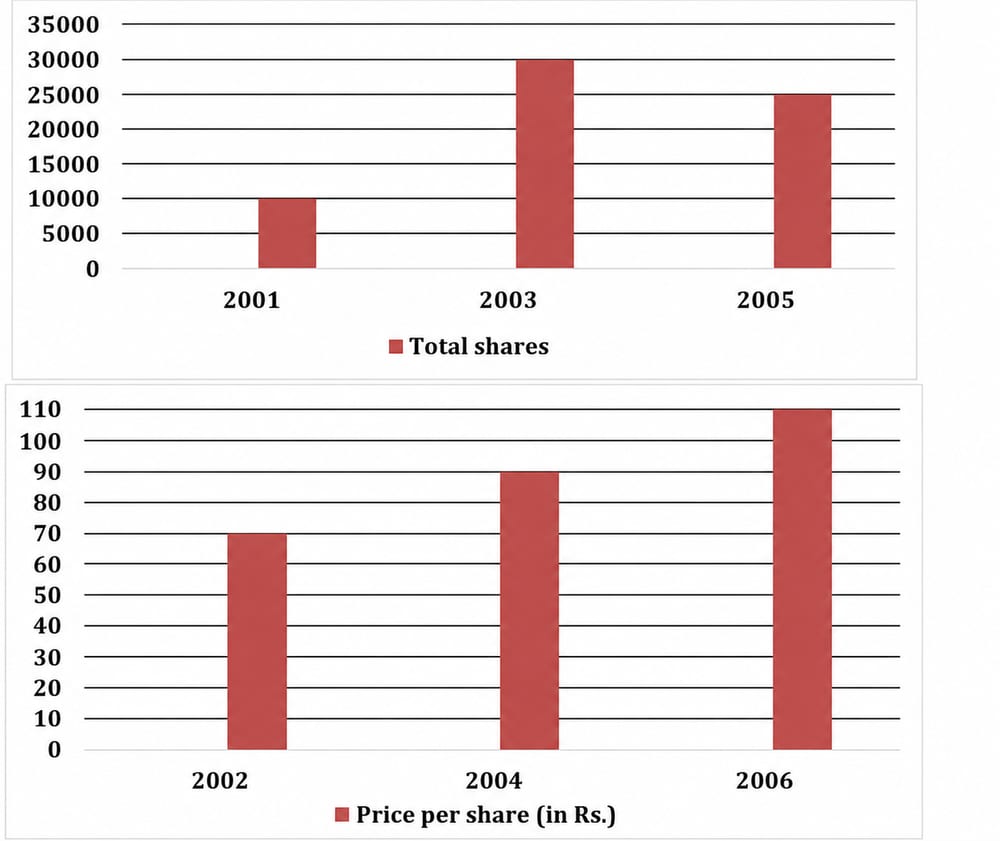
Note: (i) Market value = Total number of shares × price of one share
(ii) Number of shares increased by 20% from 2001 to 2002 and price of share decreased by 5% from 2002 to 2003. (iii) Price of share decreased by 12% from 2005 to 2006 and number of shares decreased by 10% 2005 to 2006.
Find the percentage of increment in total market value in 2003 over 2002?
Answer: D. 137.5% — ConceptMarket value of a stock = (total number of shares) × (price of one share). To compare two years, compute each year’s market value, then percentage…
- A.
117.5%
- B.
132.5%
- C.
125.5%
- D.
137.5%
- E.
127.5%
Attempted by 10 students.
Show answer & explanation
Correct answer: D
Concept
Market value of a stock = (total number of shares) × (price of one share). To compare two years, compute each year’s market value, then percentage change = (new value − old value) ÷ (old value) × 100.
A key idea: successive percentage changes act on the running base — a +20% followed by other changes is applied multiplicatively (×1.20), never added in. Read each base year’s figure from the correct chart before applying any stated change.
Application
Shares in 2002: the 2001 bar gives 10000 shares, and shares rose 20% from 2001 to 2002, so shares in 2002 = 10000 × 1.20 = 12000.
Price in 2002: read directly from the price chart = Rs. 70.
Market value in 2002 = 12000 × 70 = Rs. 8,40,000.
Price in 2003: it fell 5% from the 2002 price, so price in 2003 = 70 × 0.95 = Rs. 66.5.
Shares in 2003: read directly from the shares chart = 30000.
Market value in 2003 = 30000 × 66.5 = Rs. 19,95,000.
Percentage increment = (19,95,000 − 8,40,000) ÷ 8,40,000 × 100 = 11,55,000 ÷ 8,40,000 × 100 = 137.5%.
Cross-check
As a ratio, 19,95,000 ÷ 8,40,000 = 2.375, i.e. the 2003 market value is 2.375 times the 2002 value — an increase of 1.375, or 137.5%. The two independent routes agree, confirming the result.