Directions : Solve the given equations and answer the question given below.…
2024
Directions : Solve the given equations and answer the question given below.
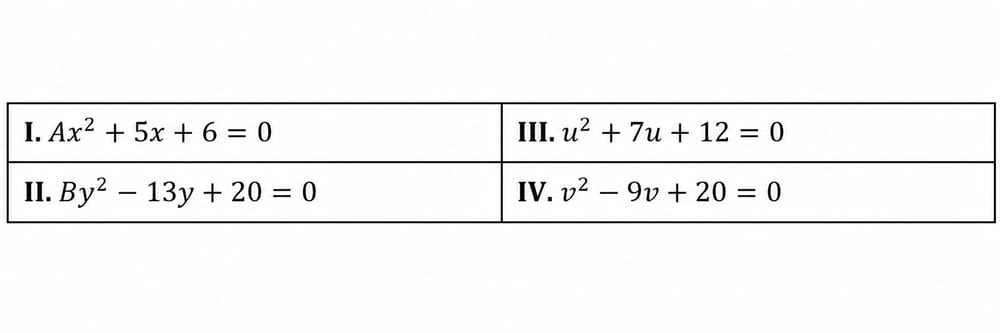
Note: (i) Sum of co-efficient of x2, x, y2 and y is -5.
(ii) Roots of all the equations are non-imaginary.
(iii) Both A & B are positive integers.
If 6 is subtract from smaller root of equation III and add the resultant to the value of B, then find the square of the resultant number.
Answer: B. 64 — ConceptFor a quadratic ax2 + bx + c = 0, the sum of the two roots is -b/a and their product is c/a; the roots are real (non-imaginary) only when the…
- A.
225
- B.
64
- C.
81
- D.
144
- E.
121
Attempted by 11 students.
Show answer & explanation
Correct answer: B
Concept
For a quadratic ax2 + bx + c = 0, the sum of the two roots is -b/a and their product is c/a; the roots are real (non-imaginary) only when the discriminant b2 - 4ac is at least 0. A given coefficient-sum condition plus the real-root requirement pins down the unknown leading coefficients, after which each equation can be factorised to read off its roots.
Application
Coefficient-sum condition. The coefficient of x2 is A, of x is 5, of y2 is B, of y is -13. So A + 5 + B - 13 = -5, which gives A + B = 3.
Use the positive-integer and real-root rules. With A and B positive integers and A + B = 3, the only candidates are (A, B) = (1, 2) and (2, 1). Equation I has real roots only if 52 - 4(A)(6) is at least 0, i.e. 25 - 24A is at least 0, forcing A = 1. Hence A = 1 and B = 2 (and 2y2 - 13y + 20 = 0 then has discriminant 169 - 160 = 9, so equation II is real too).
Roots of equation III. u2 + 7u + 12 = 0 factorises as (u + 3)(u + 4) = 0, so u = -3 or u = -4. The smaller root is -4.
Build the resultant. Subtract 6 from the smaller root: -4 - 6 = -10. Add this to the value of B (= 2): -10 + 2 = -8.
Square it: (-8)2 = 64.
Cross-check
Plug A = 1 into equation I: x2 + 5x + 6 = (x + 2)(x + 3), real roots -2, -3, consistent with note (ii). The chain -4 (smaller root) -> -10 (after subtracting 6) -> -8 (after adding B = 2) squares to 64, which matches an offered value.