Consider the following processes, all arriving at time 0, with their…
2023
Consider the following processes, all arriving at time 0, with their respective burst times:
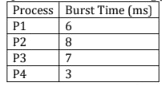
Using Non-Preemptive Shortest Job First (SJF) scheduling, calculate the average waiting time.
Answer: A. 7.0 ms — ConceptIn Non-Preemptive Shortest Job First (SJF) scheduling, whenever the CPU is free it picks the ready process with the smallest CPU burst and runs it to…
- A.
7.0 ms
- B.
6.25 ms
- C.
5.0 ms
- D.
6.0 ms
- E.
5.5 ms
Attempted by 143 students.
Show answer & explanation
Correct answer: A
Concept
In Non-Preemptive Shortest Job First (SJF) scheduling, whenever the CPU is free it picks the ready process with the smallest CPU burst and runs it to completion without interruption. A process's waiting time is the total time it spends in the ready queue before it starts executing; for processes that all arrive at time 0, that equals the sum of the burst times of every process scheduled ahead of it. Average waiting time (AWT) is the mean of the individual waiting times.
Application
All four processes arrive at time 0, so SJF simply orders them by increasing burst time and runs them one after another:
Order of execution | Process | Burst (ms) | Starts at | Waiting time (ms) |
|---|---|---|---|---|
1st | burst 3 | 3 | 0 | 0 |
2nd | burst 6 | 6 | 3 | 3 |
3rd | burst 7 | 7 | 9 | 9 |
4th | burst 8 | 8 | 16 | 16 |
Building up the waiting time step by step:
The 3 ms process runs first: it starts immediately, so its waiting time is 0.
The 6 ms process runs next: it waited while the 3 ms process ran, so its waiting time is 3.
The 7 ms process runs next: it waited for 3 + 6, so its waiting time is 9.
The 8 ms process runs last: it waited for 3 + 6 + 7, so its waiting time is 16.
AWT = (0 + 3 + 9 + 16) / 4 = 28 / 4 = 7.0 ms.
Cross-check
Independent check using turnaround time: the completion times are 3, 9, 16, 24, so the turnaround times are 3, 9, 16, 24. Subtracting each burst (3, 6, 7, 8) gives waiting times 0, 3, 9, 16, whose mean is again 7.0 ms. SJF is also optimal here: it gives the smallest possible average waiting time for this set, which any other order (for example first-come-first-served) would only increase.