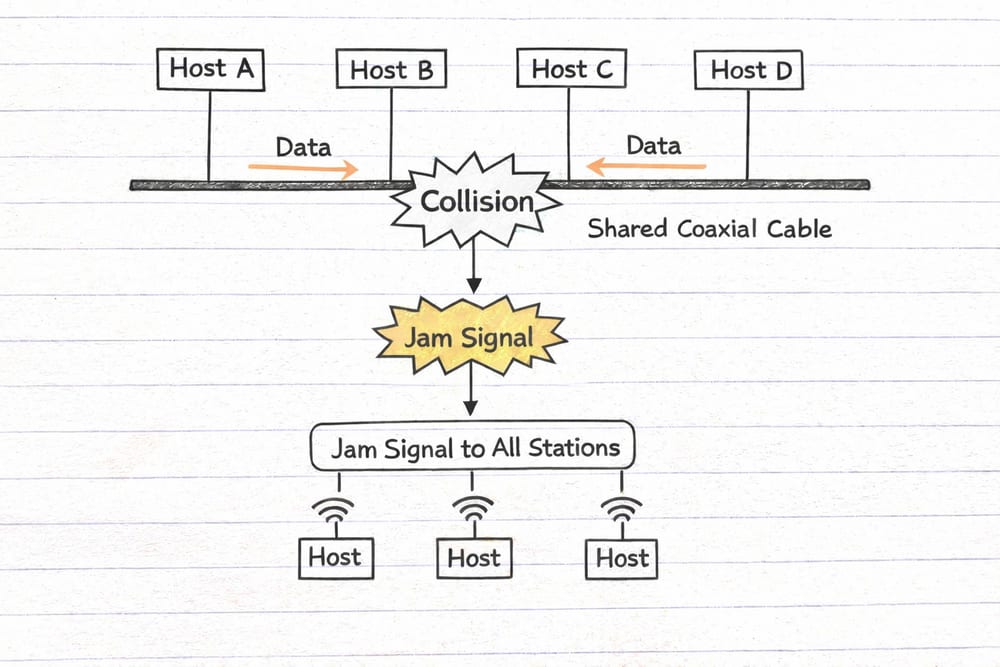
Consider that an organization uses an Ethernet LAN based on CSMA/CD protocol…
2025
Consider that an organization uses an Ethernet LAN based on CSMA/CD protocol over a shared coaxial cable medium. The maximum cable length is 2500 meters and the signal propagation speed is approximately 2 × 10⁸ m/s. The minimum frame size is 512 bits, and the transmission rate is 10 Mbps. Now, answer the following questions:
(a) Explain how CSMA/CD works in this scenario and how it will handle the collisions.
(b) Compute the minimum frame transmission time required to ensure collision detection.
(c) Justify whether the minimum Ethernet frame size of 64 bytes is sufficient for proper collision detection.
(d) Compare CSMA/CD and CSMA/CA in terms of collision handling in high-traffic environments.
Attempted by 44 students.
Show answer & explanation
CSMA/CD in Ethernet LAN
(a) Working of CSMA/CD
CSMA/CD (Carrier Sense Multiple Access with Collision Detection) is used in wired networks to manage data traffic.
Carrier Sense: A station listens to the cable. If it is idle, it starts sending data.
Collision Detection: While sending, the station continues to monitor the cable. If two stations send at the same time, a collision occurs.
Jam Signal: Upon detecting a collision, the station stops and sends a 'Jam Signal' to inform everyone.
Backoff: It then waits for a random time (Binary Exponential Backoff) before trying again.
(b) Minimum Frame Transmission Time (Tt)
For collision detection to work, a station must still be transmitting when the collision signal returns.
Given: Distance = 2500 m, Speed = 2 * 108 m/s.
Propagation Delay (Tp): Tp = Distance / Speed = 2500 / 2 * 108 = 12.5 μs.
Required Tt: 2 Tp = 2 * 12.5 = 25 μs.
(c) Justification of 64-byte Frame
Frame Size: 64 bytes = 512 bits.
Bandwidth: 10 Mbps (107 bps).
Actual Tt: 512 / 107 = 51.2μs.
Justification: Since 51.2 μs is greater than 25 μs, the 64-byte size is sufficient. The station will detect the collision before it finishes sending the frame.
(d) Comparison: CSMA/CD vs CSMA/CA
Feature | CSMA/CD (Wired) | CSMA/CA (Wireless) |
Method | Detects collision after it happens. | Tries to avoid collision before it happens. |
Strategy | Uses Jam Signal. | Uses RTS/CTS (Request to Send/Clear to Send). |
Traffic | Performance drops in high traffic. | More stable in high-traffic wireless nodes. |