Match List-I with List-II Choose the correct answer from the options given…
2023
Match List-I with List-II
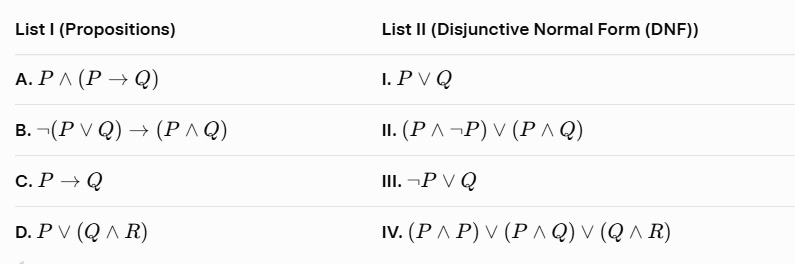
Choose the correct answer from the options given below :
- A.
(A)-(I),(B)-(II),(C)-(III),(D)-(IV)
- B.
(A)-(II),(B)-(I),(C)-(III),(D)-(IV)
- C.
(A)-(III),(B)-(I),(C)-(II),(D)-(IV)
- D.
(A)-(IV),(B)-(III),(C)-(II),(D)-(I)
Attempted by 150 students.
Show answer & explanation
Correct answer: B
Solution: Compute the Disjunctive Normal Form (DNF) of each proposition and match accordingly.
For P ∧ (P → Q): rewrite implication as ¬P ∨ Q, so P ∧ (P → Q) = P ∧ (¬P ∨ Q) = (P ∧ ¬P) ∨ (P ∧ Q).
For ¬(P ∨ Q) → (P ∧ Q): an implication X → Y is ¬X ∨ Y, so ¬(P ∨ Q) → (P ∧ Q) = ¬¬(P ∨ Q) ∨ (P ∧ Q) = (P ∨ Q) ∨ (P ∧ Q) = P ∨ Q.
For P → Q: rewrite as P → Q = ¬P ∨ Q.
For P ∨ (Q ∧ R): expand to full DNF by distributing P over the conjunction: P ∨ (Q ∧ R) = (P ∨ Q) ∧ (P ∨ R) = (P ∧ P) ∨ (P ∧ Q) ∨ (P ∧ R) ∨ (Q ∧ R).
Final matching:
P ∧ (P → Q) matches (P ∧ ¬P) ∨ (P ∧ Q).
¬(P ∨ Q) → (P ∧ Q) matches P ∨ Q.
P → Q matches ¬P ∨ Q.
P ∨ (Q ∧ R) matches (P ∧ P) ∨ (P ∧ Q) ∨ (P ∧ R) ∨ (Q ∧ R).