G1 and G2 are two graphs as shown in figure?
2012
G1 and G2 are two graphs as shown in figure?
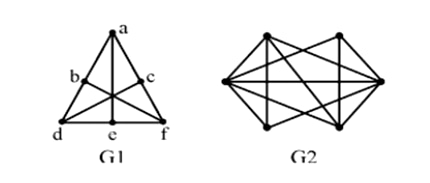
- A.
Both G1 and G2 are planar graphs
- B.
Both G1 and G2 are not planar graphs
- C.
G1 is planar and G2 is not planar
- D.
G1 is not planar and G2 is planar
Attempted by 44 students.
Show answer & explanation
Correct answer: D
Concept: A graph is planar if it can be drawn in the plane with no two edges crossing except at a shared endpoint. By Kuratowski's theorem, a graph is non-planar exactly when it contains a subdivision of K5 (the complete graph on 5 vertices) or K3,3 (the complete bipartite graph on two sets of 3 vertices) — and whether one particular drawing happens to show crossings is irrelevant; planarity asks whether ANY crossing-free drawing exists.
Application — checking G1:
List every edge of G1 from the figure: a–b, a–c, a–e, b–d, b–f, c–d, c–f, d–e, e–f (9 edges in all).
Group the six vertices into {a, d, f} and {b, c, e}: every vertex in the first group is joined to all three vertices of the second group, and to no vertex of its own group (no a–d, a–f, d–f, b–c, b–e, or c–e edge exists).
That adjacency pattern — every vertex of one 3-set joined to every vertex of the other 3-set, and nothing else — is exactly the complete bipartite graph K3,3.
K3,3 is one of Kuratowski's two forbidden graphs, so any graph containing it (here, G1 IS it) has no crossing-free drawing: G1 is non-planar.
Application — checking G2:
List every edge of G2 from the figure: 12 edges in total, with two vertices (call them L and R) each joined to all four remaining vertices and to each other, plus three further edges forming a chain among those four remaining vertices.
Redraw the chain of four vertices in a straight row; place L above the row and join it to all four (a fan of triangles, no crossings); place R below the row and join it to all four the same way (a second fan, no crossings).
This crossing-free double fan already uses 11 of the 12 edges; the only edge left is L–R, and L, R sit on opposite corners of the single remaining open region, so that last edge can be drawn straight through it without touching any other line.
All 12 edges are now drawn with zero crossings, so G2 is planar — even though the figure's own layout happens to show many crossings.
Cross-check: For any simple planar graph on V vertices, E is at most 3V minus 6; with V = 6 that allows at most 12 edges. G2 has exactly 12 edges and the crossing-free drawing above triangulates every face (8 faces in all, every one a triangle), so it sits right at the maximum — consistent with being planar. G1 has only 9 edges, well inside that bound, yet is still non-planar: satisfying the edge-count bound is necessary but never sufficient for planarity — a graph must also avoid a K5 or K3,3 subdivision.
Result: G1 is not planar and G2 is planar.
A video solution is available for this question — log in and enroll to watch it.