A Turing Machine for the language L = { aⁿ bᵐ cⁿ dᵐ | n ≥ 1, m ≥ 1 } is…
2022
A Turing Machine for the language L = { aⁿ bᵐ cⁿ dᵐ | n ≥ 1, m ≥ 1 } is designed. The resultant model is
M = ({q0, q1, q2, q3, q4, q5, q6, q7, qf}, {a, b, c, d, X1, X2, Y1, Y2}, δ, q0, B, {qf})
Part of it is given in the transition table. You need to write the following questions based on the design of Turing Machine for the given language. Note that while designing the Turing Machine, X1 and X2 are used to work with a’s and c’s and Y1 and Y2 are used to handle b’s and d’s of the given strings.
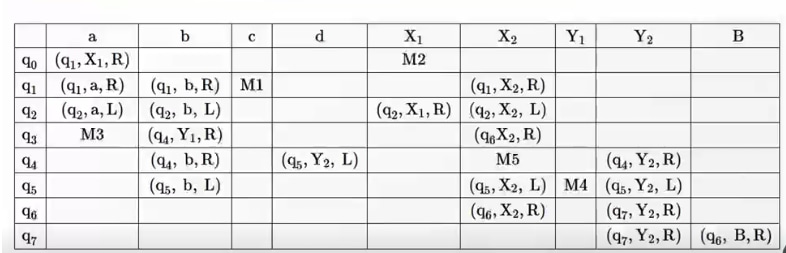
What is the Move in the cell with number ‘M1’ of a resultant table?
- A.
(q2, X2, R)
- B.
(q2, X2, L)
- C.
(q3, X2, L)
- D.
Error Entry
Attempted by 16 students.
Show answer & explanation
Correct answer: B
The Turing Machine is designed for the language L = { a^n b^m c^n d^m }. The first phase involves matching 'a's with 'c's using markers X1 and X2. State q1 is responsible for scanning right to find a 'c' that corresponds to an already marked 'a'. When the machine in state q1 reads a 'c' at cell M1, it must mark this 'c' with X2 to indicate a successful match. After marking, the machine needs to return left to find the next 'a' for the subsequent iteration. Therefore, M1 should be (q2, X2, L).
A video solution is available for this question — log in and enroll to watch it.