A binary 3-bit down counter uses J-K flip-flops, FF_i with inputs J_i, K_i and…
2017
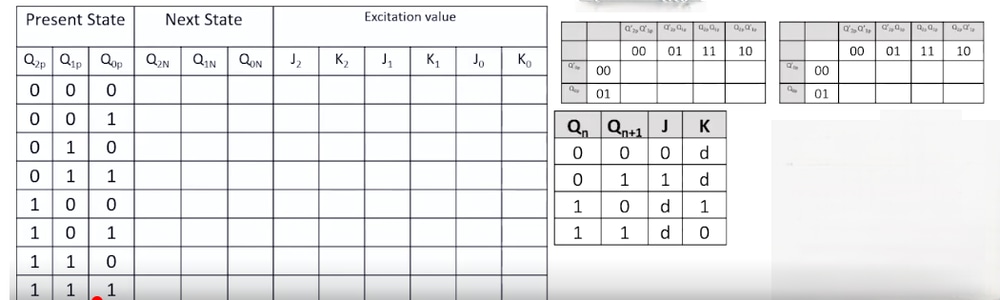
A binary 3-bit down counter uses J-K flip-flops, FF_i with inputs J_i, K_i and outputs Q_i, i = 0, 1, 2 respectively. The minimized expression for the input from following is

I. J₀ = K₀ = 0
II. J₀ = K₀ = 1
III. J₁ = K₁ = Q₀
IV. J₁ = K₁ = Q̅₀
V. J₂ = K₂ = Q₁Q₀
VI. J₂ = K₂ = Q̅₁Q̅₀
- A.
I,III,V
- B.
I,IV,VI
- C.
II,III,V
- D.
II,IV,VI
Attempted by 38 students.
Show answer & explanation
Correct answer: D
In a binary 3-bit down counter, the least significant bit (Q0) toggles on every clock pulse. For a J-K flip-flop to toggle, both inputs must be high (1), so J0 = K0 = 1.
The second bit (Q1) toggles only when the current state of Q0 is 0, meaning J1 = K1 = NOT(Q0). The most significant bit (Q2) toggles only when both lower bits are 0, requiring J2 = K2 = NOT(Q1) AND NOT(Q0).
Comparing these derived expressions with the given options, we find that statements II (J0 = K0 = 1), IV (J1 = K1 = Q̅₀), and VI (J2 = K2 = Q̅₁Q̅₀) are correct.
A video solution is available for this question — log in and enroll to watch it.