Which of the following statement is correct, according to the following…
2022
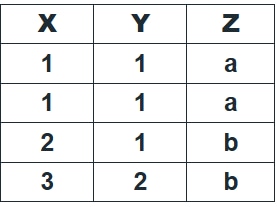
Which of the following statement is correct, according to the following instance of the relational schema R(X,Y,Z)?
- A.
\(\mathrm{X} \rightarrow \mathrm{Y}, \mathrm{Z} \rightarrow \mathrm{X}\) - B.
\(\mathrm{Y} \rightarrow \mathrm{Z}, \mathrm{Z} \rightarrow \mathrm{X}\) - C.
\(\mathrm{X} \rightarrow \mathrm{Y}, \mathrm{X} \rightarrow \mathrm{Z}\) - D.
\(\mathrm{Y} \rightarrow \mathrm{X}, \mathrm{X} \rightarrow \mathrm{Z}\)
Attempted by 627 students.
Show answer & explanation
Correct answer: C
Method: test each proposed functional dependency on the instance by comparing tuples with the same left-hand side.
Check X → Y:
Group by X: X = 1 → Y = 1; X = 2 → Y = 1; X = 3 → Y = 2. For each X value, Y is the same, so X determines Y.
Check X → Z:
Group by X: X = 1 → Z = a; X = 2 → Z = b; X = 3 → Z = b. For each X value, Z is the same, so X determines Z.
Check Z → X:
Z = b occurs in rows with X = 2 and X = 3, so Z does not uniquely determine X. Counterexample: the two tuples with Z = b have different X values.
Check Y → Z:
Y = 1 appears with Z = a (rows with X = 1) and Z = b (row with X = 2), so Y does not determine Z.
Conclusion: X determines both Y and Z in this instance, while Z does not determine X and Y does not determine Z. Therefore the correct dependency set is that X → Y and X → Z.
A video solution is available for this question — log in and enroll to watch it.