Consider the following database table having A, B, C and D as its four…
2016
Consider the following database table having A, B, C and D as its four attributes and four possible candidate keys (I, II, III and IV) for this table :
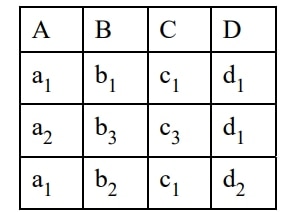
I : {B} II : {B, C} III : {A, D} IV : {C, D}
If different symbols stand for different values in the table (e.g., d1 is definitely not equal to d2), then which of the above could not be the candidate key for the database table ?
- A.
I and III only
- B.
III and IV only
- C.
II only
- D.
I only
Attempted by 590 students.
Show answer & explanation
Correct answer: C
Answer: The set {B, C} cannot be a candidate key.
Reasoning (check uniqueness and minimality):
Check single attributes for uniqueness: B takes distinct values in each row, so B alone uniquely identifies rows and therefore {B} is a candidate key.
Since B is a key by itself, any superset that contains B (for example {B, C}) is not minimal and therefore cannot be a candidate key.
Check the pairs {A, D} and {C, D}: both pairs give distinct combined values for every row, and neither A, C, nor D alone is sufficient. Thus both {A, D} and {C, D} are minimal keys (candidate keys).
Conclusion: only the set {B, C} cannot be a candidate key because it is not minimal (B alone already serves as a key).
A video solution is available for this question — log in and enroll to watch it.