Consider the following Entity-Relationship (E-R) diagram and three possible…
2016
Consider the following Entity-Relationship (E-R) diagram and three possible relationship sets (I, II and III) for this E-R diagram:
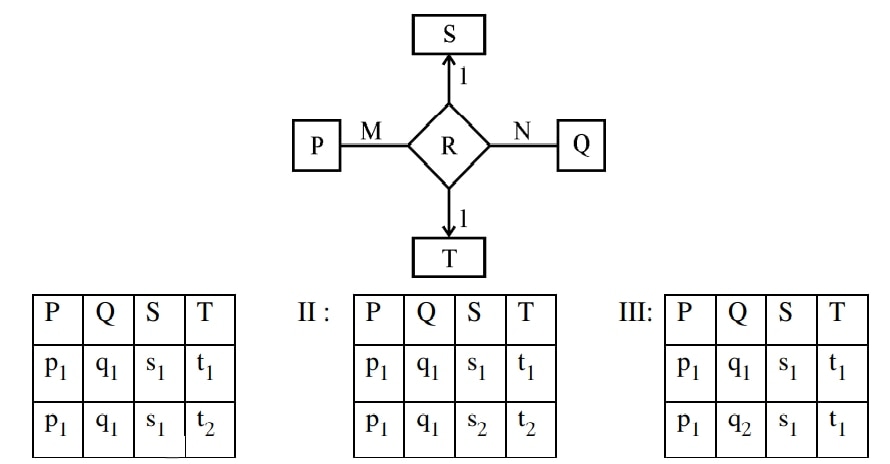
If different symbols stand for different values (e.g., t1 is definitely not equal to t2), then which of the above could not be the relationship set for the E-R diagram?
- A.
I only
- B.
I and II only
- C.
II only
- D.
I, II and III
Attempted by 602 students.
Show answer & explanation
Correct answer: A
Concept
In an n-ary relationship, an arrow (the "1") into an entity means: a particular combination of entities from all the OTHER participating entities determines at most one entity of that arrowed set (Korth/Silberschatz semantics). So the determinant of an arrowed entity is NOT one or two neighbours — it is every other entity in the relationship.
Here R is 4-ary over P, Q, S, T with M on P, N on Q, and an arrow ("1") into both S and T. Therefore:
"1" into S: each combination (P, Q, T) fixes at most one S.
"1" into T: each combination (P, Q, S) fixes at most one T.
P and Q carry M/N, so they may repeat freely.
Application to each set
Set I = {(p1, q1, s1, t1), (p1, q1, s1, t2)}: the two rows share the same (P, Q, S) = (p1, q1, s1) but give two different T values (t1 and t2). That makes (P, Q, S) map to two T values, which the "1" into T forbids. Set I is impossible.
Set II = {(p1, q1, s1, t1), (p1, q1, s2, t2)}: the rows differ in BOTH S and T. Check "1" into S using determinant (P, Q, T): the rows are (p1, q1, t1) and (p1, q1, t2) — different T, so no single (P, Q, T) is forced to two S. Check "1" into T using determinant (P, Q, S): the rows are (p1, q1, s1) and (p1, q1, s2) — different S, so no single (P, Q, S) is forced to two T. Neither arrow is violated. Set II is possible.
Set III = {(p1, q1, s1, t1), (p1, q2, s1, t1)}: the rows differ only in Q. Since Q is part of every determinant, the two (P, Q, T) combinations differ and the two (P, Q, S) combinations differ, so neither "1" arrow is breached. Set III is possible.
Cross-check (the common trap)
The frequent error is to read "1" into S as "(P, Q) determines one S" and conclude Set II also fails. That is the BINARY reading. In an n-ary relationship the determinant of S is (P, Q, T), not (P, Q). In Set II the two rows differ in T, so (p1, q1) is allowed to appear with both s1 and s2. Hence Set II does NOT violate the diagram, and only Set I is impossible.
Therefore the set that could not occur is Set I — the option naming only Set I.
A video solution is available for this question — log in and enroll to watch it.