Consider a 3-puzzle where, like in the usual 8-puzzle game, a tile can only…
2016
Consider a 3-puzzle where, like in the usual 8-puzzle game, a tile can only move to an adjacent empty space. Given the initial state
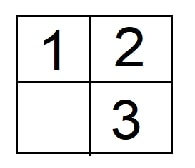 , which of the following state cannot be reached ?
Attempted by 80 students.
Show answer & explanation
Key idea: For a 2x2 sliding puzzle the reachability of a configuration from another is determined by the parity of (number of inversions among tiles) + (row index of the blank counted from the bottom). Configurations with the same parity are reachable from one another.
Initial configuration:
Top row: 1, 2; bottom row: blank, 3.
Compute parity for the initial state:
Inversions among tiles 1, 2, 3: 0.
Blank is on the bottom row, which is row 1 from the bottom.
Parity = 0 + 1 = 1 (odd). Any reachable configuration must have odd parity.
Now check each candidate configuration by computing (inversions) + (blank row from bottom):
Configuration with top row 3, 1 and bottom row blank, 2: tile order 3,1,2 has 2 inversions; blank is on bottom row (1). Sum = 2 + 1 = 3 (odd) → reachable.
Configuration with top row blank, 3 and bottom row 2, 1: tile order 3,2,1 has 3 inversions; blank is on the top row (row 2 from bottom). Sum = 3 + 2 = 5 (odd) → reachable.
Configuration with top row 1, 3 and bottom row 2, blank: tile order 1,3,2 has 1 inversion; blank is on the bottom row (1). Sum = 1 + 1 = 2 (even) → not reachable.
Configuration with top row blank, 2 and bottom row 1, 3: tile order 2,1,3 has 1 inversion; blank is on the top row (row 2 from bottom). Sum = 1 + 2 = 3 (odd) → reachable.
Conclusion: The only configuration that cannot be reached from the given initial state is the one with top row 1 and 3 and bottom row 2 with the blank in the bottom-right.
A video solution is available for this question — log in and enroll to watch it.