In an office, 3/4 of the staff can neither type nor take shorthand.However 1/5…
2023
In an office, 3/4 of the staff can neither type nor take shorthand.However 1/5 can type and 1/3rd can take shorthand. What part of the whole staff can do both ?
Answer: D. 17/60 — For two overlapping groups A and B within a whole, the inclusion-exclusion principle states n(A or B) = n(A) + n(B) - n(A and B); equivalently, if the…
- A.
1/5
- B.
3/40
- C.
13/40
- D.
17/60
Attempted by 4 students.
Show answer & explanation
Correct answer: D
For two overlapping groups A and B within a whole, the inclusion-exclusion principle states n(A or B) = n(A) + n(B) - n(A and B); equivalently, if the fraction belonging to neither group is known, the fraction in at least one group (the union) equals 1 minus that fraction.
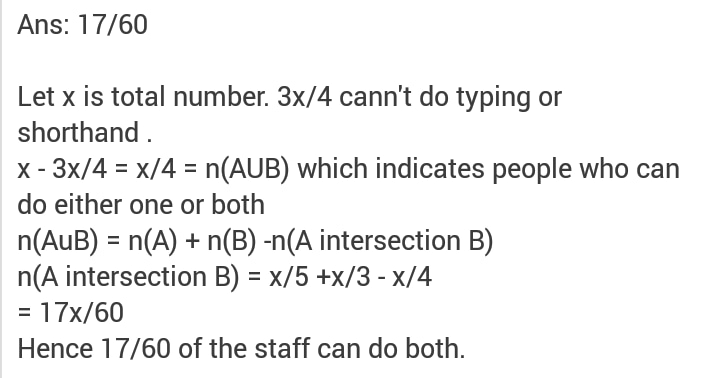
Staff who can neither type nor take shorthand = 3/4 of the total, so staff who can do at least one of the two = 1 - 3/4 = 1/4. This is n(Type or Shorthand).
Staff who can type, n(Type) = 1/5, and staff who can take shorthand, n(Shorthand) = 1/3.
Apply the inclusion-exclusion formula rearranged for the overlap: n(Type and Shorthand) = n(Type) + n(Shorthand) - n(Type or Shorthand) = 1/5 + 1/3 - 1/4.
Taking the LCM of 5, 3 and 4 as 60: 1/5 = 12/60, 1/3 = 20/60, 1/4 = 15/60, so n(Type and Shorthand) = 12/60 + 20/60 - 15/60 = 17/60.
Cross-check: adding back, n(Type or Shorthand) = 12/60 + 20/60 - 17/60 = 15/60 = 1/4, which matches the union fraction found in step 1, confirming the working.
So the fraction of the whole staff that can do both tasks is 17/60.