Study the following statements and conclusions carefully. Statements: I. All…
2023
Study the following statements and conclusions carefully.
Statements:
I. All bats are lions.
II. No cow is a lion.
III. Some camels are cows.
Conclusions:
I. Some lions are camels.
II. No camel is a bat.
III. Some bats are cows.
Assuming the statements to be true, even if they appear to differ from commonly known facts, decide which of the given conclusions logically follow(s) from the statements.
Answer: D. None of these — Concept: A conclusion in a syllogism is valid only if it is true in every possible Venn diagram consistent with the given statements, not merely in one…
- A.
Only I follows
- B.
Only II follows
- C.
Only III follows
- D.
None of these
Attempted by 6 students.
Show answer & explanation
Correct answer: D
Concept: A conclusion in a syllogism is valid only if it is true in every possible Venn diagram consistent with the given statements, not merely in one particular diagram you happen to draw. 'All A are B' places circle A completely inside circle B. 'No A is B' keeps circles A and B fully separate. 'Some A are B' requires the two circles to overlap in at least one region, while leaving open how much of A (or B) lies outside that overlap.
Application: The statements fix three relationships between the four groups. 'All bats are lions' places the Bat circle entirely inside the Lion circle. 'No cow is a lion' keeps the Cow circle fully outside the Lion circle. 'Some camels are cows' makes the Camel circle overlap the Cow circle in one region, while the rest of the Camel circle is free to lie anywhere -- exactly as shown in the diagram.
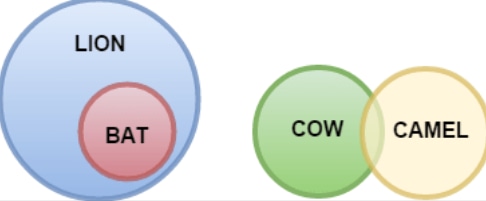
Conclusion I ('Some lions are camels') needs Lion and Camel to overlap in every valid diagram. The only camels fixed by the statements are inside Cow, which is outside Lion, so that portion never touches Lion; the unfixed portion of Camel could lie inside or outside Lion. Because a valid diagram exists either way, the overlap is not guaranteed.
Conclusion II ('No camel is a bat') needs Camel and Bat to stay separate in every valid diagram. The camels fixed inside Cow are indeed clear of Bat (since Bat is inside Lion and Cow is outside Lion), but the unfixed portion of Camel could just as easily extend into Bat. Because a valid diagram exists where they overlap, this separation is not guaranteed either.
Conclusion III ('Some bats are cows') needs Bat and Cow to overlap. Since Bat lies entirely inside Lion and Cow lies entirely outside Lion, Bat and Cow can never share a region in any diagram consistent with the statements -- this overlap is impossible.
Cross-check: Drawing two extreme, equally valid diagrams -- one where the free portion of Camel avoids Lion entirely, another where it overlaps Lion -- both satisfy all three statements, confirming Conclusions I and II are possible but not forced. No diagram consistent with the statements can bring Bat and Cow together, confirming Conclusion III is impossible, not just unproven.
Result: None of the three conclusions is guaranteed to follow in every valid diagram, so the correct choice is 'None of these'.