Each question below contains three statements followed by two conclusions, I…
2024
Each question below contains three statements followed by two conclusions, I and II. Assume the statements to be true, even if they appear to vary from commonly known facts, and decide which conclusion(s) logically follow from the statements, disregarding commonly known facts.
Statements:
No key is a door.
All doors are pens.
Some pens are houses.
Conclusions:
No key is a house.
Some pens are doors.
Answer: B. Only II follows — Concept: Syllogism conclusions are tested with two rules: (1) a universal affirmative statement ('All X are Y') always converts to a valid particular…
- A.
Only I follows
- B.
Only II follows
- C.
Only III follows.
- D.
Only I and II follows
Attempted by 7 students.
Show answer & explanation
Correct answer: B
Concept: Syllogism conclusions are tested with two rules: (1) a universal affirmative statement ('All X are Y') always converts to a valid particular conclusion by limitation — it guarantees 'Some Y are X'; (2) a conclusion connecting two terms across a chain of statements is valid only if every possible arrangement (Venn diagram) that satisfies all the given statements also satisfies that conclusion — if even one valid arrangement contradicts it, the conclusion does not hold.
Statement II states 'All doors are pens', so the entire door set lies inside the pen set. By the conversion rule, this guarantees 'Some pens are doors' in every arrangement that satisfies the statements — this conclusion is certain.
Statement I only removes key from the door portion of pen ('no key is door'); it says nothing about the rest of the pen set. So a part of key can still lie inside pen but outside door, and that part could fall inside the region where pen and house overlap (statement III: 'Some pens are houses').
Two different arrangements can both satisfy all three statements: one where key stays completely separate from pen and house (as in the given figure), and another where a portion of key sits inside the pen–house overlap. Because one arrangement makes 'No key is house' true and the other makes it false, this conclusion is not guaranteed by the statements.
This matches the chain check for validity: key is linked only to door (through statement I), and house is linked only to pen (through statement III) — key and house never share a directly-linking term across the chain, so no certain key–house relation can be drawn. Only the doors-to-pens conversion in statement II gives a guaranteed conclusion.
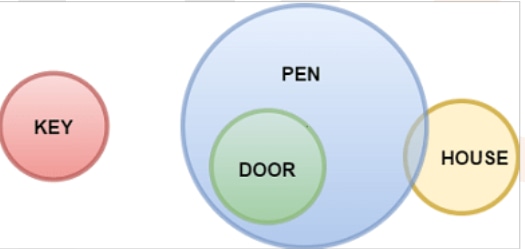
One valid arrangement satisfying all three statements — key stays fully separate, the door circle sits fully inside the pen circle, and the pen circle partly overlaps the house circle.
Therefore, only the conclusion 'Some pens are doors' logically follows from the statements.