Each of the following questions is based on the following information: 8 trees…
2024
Each of the following questions is based on the following information: 8 trees — mango, guava, papaya, pomegranate, lemon, banana, raspberry, and apple — are arranged in two rows of 4 each, facing North and South. Lemon is between mango and apple but just opposite to guava. Banana is at one end of a line and is just to the right of guava (i.e., the banana tree comes immediately after the guava tree). Raspberry, which is at one end of a line, is diagonally opposite to mango tree. Which tree is just opposite to banana tree?
Answer: A. Mango — Concept: In a two-row facing arrangement puzzle, relational clues like 'opposite', 'diagonally opposite', 'at one end', and 'adjacent to' describe RELATIVE…
- A.
Mango
- B.
Pomegranate
- C.
Papaya
- D.
Data is inadequate
Attempted by 8 students.
Show answer & explanation
Correct answer: A
Concept:
In a two-row facing arrangement puzzle, relational clues like 'opposite', 'diagonally opposite', 'at one end', and 'adjacent to' describe RELATIVE positions — on their own, they can be satisfied by two mirror-image layouts (left-right flipped). The clues fix the relative STRUCTURE of the arrangement; matching that structure against the accompanying diagram (which fixes which physical end is which) pins down the actual placement. Within that diagram's frame: 'X opposite Y' = same column, different row; 'diagonally opposite' = opposite corner cells (meaningful only when both trees sit at row-ends); 'adjacent to' = neighbouring column, same row.
Application (step by step):
Lemon is between mango and apple: these three sit consecutively in one row with Lemon in the middle — Mango-Lemon-Apple, or its mirror Apple-Lemon-Mango — occupying three of that row's four columns.
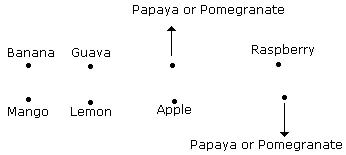
Raspberry is at one end, diagonally opposite mango: a diagonal-opposite pairing only works between corner cells, so Mango itself must sit at an end of its row. Of the two mirror options from step 1, only Mango-Lemon-Apple keeps Mango at a corner (column 1) — this is exactly the layout the accompanying diagram shows: Mango at column 1, Lemon at column 2, Apple at column 3 (column 4 of this row is one of Papaya/Pomegranate, still undetermined).
With Mango fixed at column 1, its diagonal-opposite corner is column 4 of the other row, so Raspberry occupies column 4 of the Guava/Banana row — matching the diagram.
Lemon is opposite Guava: Guava must sit in the same column as Lemon — column 2 — of the other row, as shown.
Banana is at one end of that row and adjacent to Guava (column 2): the row's two ends are columns 1 and 4; column 4 is already taken by Raspberry, so Banana occupies the remaining end, column 1 — adjacent to Guava's column 2, matching the diagram.
The two remaining trees, Papaya and Pomegranate, fill the two leftover slots — column 4 of Mango's row and column 3 of Banana's row; the clues (and the diagram) leave this particular pair unresolved, but neither slot is column 1, so it never touches Banana's column.
Reading off the fixed grid: Banana's row = Banana, Guava, (Papaya/Pomegranate), Raspberry; Mango's row = Mango, Lemon, Apple, (Papaya/Pomegranate). Banana (column 1) sits directly opposite Mango (column 1).
Cross-check:
Verify the diagram's layout against every clue: Lemon is between Mango and Apple (yes); Raspberry is at an end, diagonally opposite Mango (yes — both at the column-1/column-4 corners); Lemon is opposite Guava (yes); Banana is at an end and adjacent to Guava (yes). All four clues hold, and this is the only layout (up to the harmless Papaya/Pomegranate swap) consistent with them — so the tree directly opposite Banana is Mango.