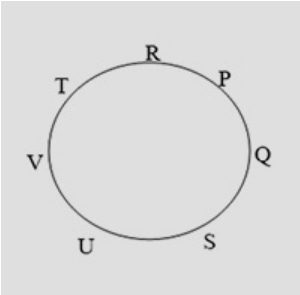
P, Q, R, S, T, U and V are seven friends sitting in a circle, facing the…
2025
P, Q, R, S, T, U and V are seven friends sitting in a circle, facing the centre of the circle.
V is second to the left of S and is the neighbour of both T and U.
S is not a neighbour of R or T.
P is a neighbour of both Q and R.
Which of the following pairs has the second person sitting to the immediate right of the first person?
Answer: B. US — Concept: When everyone in a circular arrangement faces the CENTRE, left and right are mirrored compared to facing outward — each person's LEFT points in the…
- A.
QU
- B.
US
- C.
TR
- D.
PT
Attempted by 2 students.
Show answer & explanation
Correct answer: B
Concept: When everyone in a circular arrangement faces the CENTRE, left and right are mirrored compared to facing outward — each person's LEFT points in the clockwise direction and their RIGHT points in the anticlockwise direction. So “k-th to the left of X” means k seats clockwise from X, and “Y sits immediately to the right of X” means Y occupies the one seat immediately anticlockwise-adjacent to X.
Application:
Fix S as the reference seat and label the seats 0 to 6 going clockwise.
Since V is second to the left of S, and left is the clockwise direction here, V sits 2 seats clockwise from S (seat 2).
V's two neighbours are T and U, so the seats immediately adjacent to V (seats 1 and 3) are occupied by T and U in some order.
S's two neighbouring seats are seat 6 and seat 1. Because S cannot neighbour T, seat 1 must be U, which forces seat 3 to be T.
S also cannot neighbour R, so seat 6 cannot hold R; P, Q and R must fill the remaining seats 4, 5 and 6.
P needs BOTH Q and R as neighbours. Among seats 4, 5 and 6, only seat 5 has both its neighbouring seats (4 and 6) inside this trio, since seats 4 and 6 each also border someone outside the trio (T and S). So P sits at seat 5, with Q and R at seats 4 and 6.
Since seat 6 cannot be R, seat 6 must be Q and seat 4 must be R.
Cross-check: Reading the finished chart clockwise gives S, U, V, T, R, P, Q. Checking every clue against it: V's neighbours are U and T; S's neighbours are Q and U, never R or T; P's neighbours are R and Q — all four conditions hold together.
Result: U's immediate anticlockwise-adjacent seat — which is U's “right”, since everyone faces the centre — is occupied by S, so the pair U-S is the one where the second person sits immediately to the right of the first.