B is South-West of A, C is to the East of B and South-East of A and D is to…
B is South-West of A, C is to the East of B and South-East of A and D is to the North of C in line with B and A. In which direction of A is D located?
Answer: D. North-East — Concept: In direction-sense reasoning, plot each stated movement on a two-axis compass frame (East-West as the horizontal axis, North-South as the vertical…
- A.
North
- B.
East
- C.
South-West
- D.
North-East
Attempted by 3 students.
Show answer & explanation
Correct answer: D
Concept: In direction-sense reasoning, plot each stated movement on a two-axis compass frame (East-West as the horizontal axis, North-South as the vertical axis); composite directions such as North-East or South-West are diagonal blends of both axes. When several movements are chained one after another, the final direction of the last point from the first must be found by combining the net offset on BOTH axes across the whole chain -- reading off just one leg of the chain in isolation gives the wrong direction.
Application: Trace the chain A -> B -> C -> D step by step, placing A at the origin.
B is South-West of A: this gives B a southward offset and a westward offset from A.
C is East of B: C keeps B's southward offset but shifts further East. The passage independently states C is also South-East of A, which is consistent -- C is still South of A (via B's offset) and now East of A too (via the eastward shift past B).
D is North of C: D keeps C's eastward offset (so D is East of A) but shifts upward (North) from C's position.
D also lies in line with B and A, on the straight line through B and A extended -- and since D is North of C rather than South, D must sit on the far side of A from B, not between B and A.
Cross-check: The passage's own diagram plots exactly this layout -- B at the bottom-left, C at the bottom-right (East of B), D directly above C, and the line from B through A to D drawn as one straight diagonal, labelled N-E where it passes A. This independently confirms the step-by-step offset reasoning above.
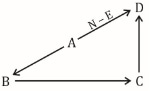
Result: Combining a net eastward offset (from C and D both lying East of A) with a net northward offset (from D lying above C, on the far side of A from B) places D North-East of A.