Town D is 13 km to the East of Town A. A bus starts from Town A, travels 8 km…
2025
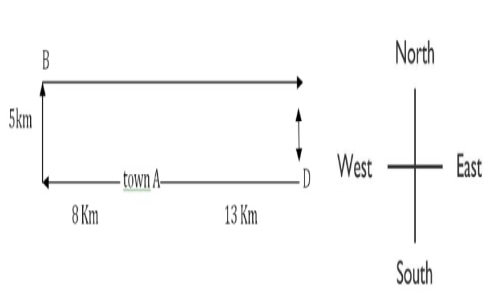
Town D is 13 km to the East of Town A. A bus starts from Town A, travels 8 km towards the West, and takes a right turn. After the turn, it travels 5 km and reaches Town B. From Town B, the bus takes a right turn again and travels 21 km, then stops. How far, and in which direction, must the bus travel to reach Town D?
Answer: D. 5 km towards South — In direction-and-distance problems, fix the starting point at coordinates (0, 0) and track East–West movement on one axis and North–South movement on the…
- A.
13 km towards South
- B.
13 km towards North
- C.
19 km towards South
- D.
5 km towards South
Show answer & explanation
Correct answer: D
In direction-and-distance problems, fix the starting point at coordinates (0, 0) and track East–West movement on one axis and North–South movement on the other; each turn only changes the axis of the next leg. The answer to 'how far and which way to reach a target point' is simply the gap between the traveller's current position and the target, found by comparing the two coordinates.
Fix Town A at the origin (0, 0). Since Town D is 13 km East of A, Town D is at (13, 0).
The bus travels 8 km West from A, reaching (−8, 0).
Facing West, a right turn changes the heading to North. Travelling 5 km North brings the bus to Town B at (−8, 5).
Facing North, the next right turn changes the heading to East. Travelling 21 km East moves the x-coordinate from −8 to −8 + 21 = 13, giving the bus's stopping point as (13, 5).
Comparing (13, 5) with Town D at (13, 0): the x-coordinates already match, so only the y-coordinate differs — by 5 units.
Since the bus's y-coordinate (5) is greater than Town D's (0), the bus is North of Town D, so it must travel 5 km South to reach it.
Cross-check using only the East–West totals: the bus travels 8 km West then 21 km East, a net 21 − 8 = 13 km East of A — exactly Town D's East offset — confirming the bus and Town D share the same East–West position. The only outstanding gap is the 5 km North–South offset built up on the single North leg, closed by heading South.