Rahul took part in a cycling race with several other participants on a…
2023
Rahul took part in a cycling race with several other participants on a circular track. Of the participants other than Rahul, 1/5 were ahead of him and 5/6 were behind him; the number of participants ahead of him and the number of participants behind him together add up to the total number of participants taking part in the race. Find the total number of participants.
Answer: B. 31 — Concept: In race problems that give one fraction 'ahead' and one fraction 'behind', first fix the REFERENCE SET each fraction acts on, write the ahead-count…
- A.
15
- B.
31
- C.
29
- D.
23
Attempted by 96 students.
Show answer & explanation
Correct answer: B
Concept: In race problems that give one fraction 'ahead' and one fraction 'behind', first fix the REFERENCE SET each fraction acts on, write the ahead-count and behind-count as those fractions of that set, and then turn the problem's STATED verbal condition into a single equation in the unknown total; when the two fractions add to more than 1 the relation is not a physical split of the reference set but a numerical condition to be solved exactly as given. Here the reference set is the participants other than Rahul (x − 1), and the stated condition is that the ahead-count plus the behind-count equals the TOTAL number of participants x — one more than the x − 1 others themselves, which is exactly what makes the fractions 1/5 and 5/6 combine into a solvable equation.
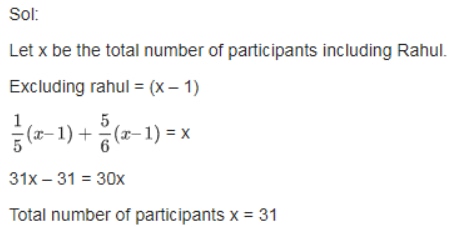
Let x = total number of participants, so everyone besides Rahul numbers (x − 1).
Participants ahead of Rahul = 1/5 × (x − 1); participants behind Rahul = 5/6 × (x − 1).
Apply the stated condition: 1/5(x − 1) + 5/6(x − 1) = x.
Take the LCM of 5 and 6 (= 30): 6/30(x − 1) + 25/30(x − 1) = x, that is, 31/30(x − 1) = x.
Cross-multiply: 31(x − 1) = 30x, so 31x − 31 = 30x, giving x = 31.
Verification: with x = 31, the other 30 participants give 1/5 × 30 = 6 ahead and 5/6 × 30 = 25 behind; 6 + 25 = 31, matching the stated condition that these two counts add up to the total number of participants (not just the other 30) — confirming x = 31.