The marked price of a shirt is Rs.1000. A shopkeeper offers 10% discount on…
2024
The marked price of a shirt is Rs.1000. A shopkeeper offers 10% discount on this shirt and then again offers 20% discount on the new price. How much will you have to pay, finally?
- A.
Rs. 700
- B.
Rs. 720
- C.
Rs. 300
- D.
Rs. 760
Show answer & explanation
Correct answer: B
Concept: When two discounts are applied one after another on a marked price, each discount is calculated on the price that remains after the previous discount, not on the original marked price — successive discounts compound multiplicatively rather than simply adding up. For discounts of d1% and d2% applied in sequence, final price = Marked Price × (1 − d1/100) × (1 − d2/100).
The marked price is Rs. 1000.
Applying the first 10% discount: new price = 1000 × (1 − 10/100) = 1000 × 0.9 = Rs. 900.
Applying the second 20% discount on this new price of Rs. 900: final price = 900 × (1 − 20/100) = 900 × 0.8 = Rs. 720.
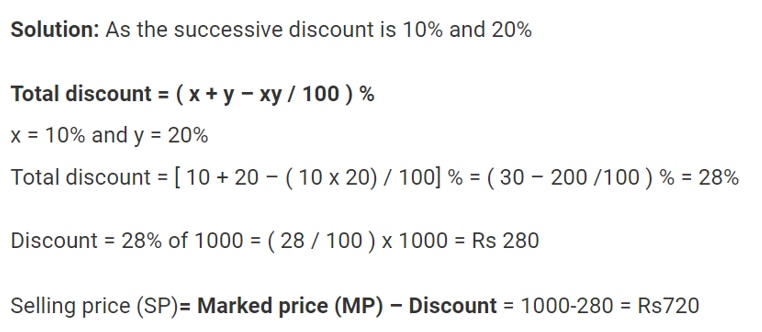
Cross-check: two successive discounts of 10% and 20% combine into one effective discount of 10 + 20 − (10 × 20)/100 = 28% on the marked price. 28% of Rs. 1000 is Rs. 280, so the price paid is Rs. 1000 − Rs. 280 = Rs. 720 — the same result as the step-by-step calculation, confirming it.
So, the final amount to be paid is Rs. 720.
Reference working: