Hira walks 10 m towards West. He turns left and walks 8 m. He then turns right…
2023
Hira walks 10 m towards West. He turns left and walks 8 m. He then turns right and walks 8 m. He then turns left and walks 5 m, then turns left and walks 13 m, and then turns left and walks 11 m. What is the total distance covered by him and the direction of his initial position with respect to his final position?
Answer: A. 55 m, North East — Concept In a direction-sense (path-tracing) problem, plot each straight segment on a compass grid with East as the positive x-axis and North as the positive…
- A.
55 m, North East
- B.
43 m, South East
- C.
40 m, North West
- D.
52 m, North East
Attempted by 1 students.
Show answer & explanation
Correct answer: A
Concept
In a direction-sense (path-tracing) problem, plot each straight segment on a compass grid with East as the positive x-axis and North as the positive y-axis. A left turn rotates the current heading 90° anticlockwise and a right turn rotates it 90° clockwise; turns do not add to the distance travelled. The total distance is simply the sum of the lengths of every straight segment. The direction of one point relative to another is read from the straight-line displacement vector joining them against the compass rose — not from the shape of the path.
Application
Taking the starting point A as (0, 0), with East as +x and North as +y, trace each leg of Hira's walk:
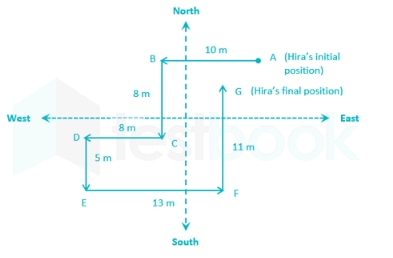
Leg | Heading | Distance (m) | Position reached |
|---|---|---|---|
A → B | West | 10 | (−10, 0) |
B → C | South (after turning left) | 8 | (−10, −8) |
C → D | West (after turning right) | 8 | (−18, −8) |
D → E | South (after turning left) | 5 | (−18, −13) |
E → F | East (after turning left) | 13 | (−5, −13) |
F → G | North (after turning left) | 11 | (−5, −2) |
Total distance covered = 10 + 8 + 8 + 5 + 13 + 11 = 55 m. The final position is G = (−5, −2), while the initial position is A = (0, 0). The displacement from G to A is (0 − (−5), 0 − (−2)) = (5, 2) — that is, 5 m to the east and 2 m to the north of G. A point that lies to the east and to the north of another point lies in its North-East direction, so the initial position A is North-East of the final position G.
Cross-check
Summing the east–west components independently confirms this: the westward legs (10 m + 8 m = 18 m) exceed the eastward leg (13 m) by 5 m, so G is 5 m west of A. Summing the north–south components: the southward legs (8 m + 5 m = 13 m) exceed the northward leg (11 m) by 2 m, so G is 2 m south of A. Since G is west and south of A, A must be east and north of G — i.e., North-East — matching the vector calculation above.