Which option replaces the question mark given in the Question above?
2023
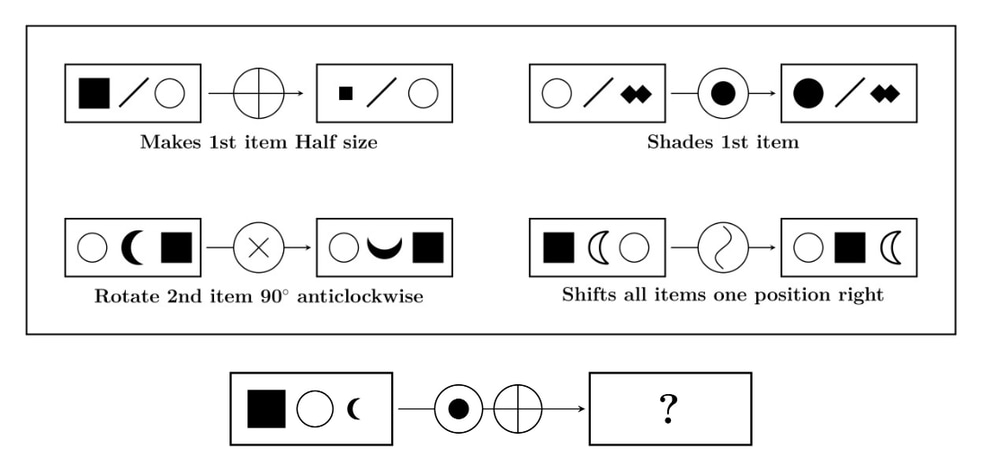
Which option replaces the question mark given in the Question above?
Attempted by 194 students.
Show answer & explanation
Concept: In this operator-based figure-reasoning type, each symbol (a filled circle, a target-like circle, a circle with a cross, and an S-curve circle) is a rule defined by one worked example: comparing the box before the arrow with the box after it tells you exactly what that operator does to the box. When two operators are chained one after another, each is applied in the given left-to-right order, and here every operator acts only on the leftmost item of the box, leaving every other item untouched.
Application:
From the top-right worked example, the filled black circle operator's rule is "Shades 1st item": it turns the leftmost item of the box fully black (solid), while the other two items stay exactly as they were.
From the top-left worked example, the target-like circle operator's rule is "Makes 1st item Half size": it shrinks the leftmost item of the box to half its size, while the other two items again stay exactly as they were.
The given box is [a solid black square, an unfilled circle, an unfilled crescent], and it is processed first by the "Shades 1st item" operator, then by the "Makes 1st item Half size" operator.
Applying the shading rule first: the square, being the leftmost item, is already fully black, so shading it makes no visible difference and it stays a solid black square. The circle and the crescent are not the leftmost item, so this operator does not touch them.
Applying the half-size rule next, to that result: the solid black square, still the leftmost item, shrinks to half its size, becoming a small solid black square. The circle and the crescent are still not the leftmost item, so they remain exactly as given: an unfilled circle and an unfilled crescent.
So the final box must show, left to right: a small solid black square, an unfilled (outline) circle, and an unfilled (outline) crescent.
Cross-check: Because both rules explicitly act only on the leftmost item, applying them in the reverse order gives the same result here: halving the solid black square first gives a small solid black square, and shading an already-black square changes nothing further - so the result does not depend on the order for this particular pair of operators.