A person starts at point H and walks 4 m towards the East to reach point G.…
A person starts at point H and walks 4 m towards the East to reach point G. From G, he walks 8 m towards the South to reach point F. From F, he walks 6 m towards the East to reach point E. From E, he walks 10 m towards the North to reach point D.
In which direction is point H with respect to point D?
Answer: B. South-west — Concept: In a direction-sense problem, treat every straight-line move as a vector on a coordinate plane with East = +x and North = +y (so West = -x and South…
- A.
West
- B.
South-west
- C.
North-west
- D.
East
Attempted by 2 students.
Show answer & explanation
Correct answer: B
Concept: In a direction-sense problem, treat every straight-line move as a vector on a coordinate plane with East = +x and North = +y (so West = -x and South = -y). Build up each point's coordinates by adding its displacement to the previous point, then compare the target point's coordinates with the reference point's coordinates. If both the horizontal (x) and vertical (y) differences are non-zero, the required direction is the matching intercardinal direction (e.g., x negative with y negative gives South-West), no matter which of the two differences is larger.
Let F = (0, 0) be the origin.
F to G is 8 m North, so G = (0, 8).
G to H is 4 m West, so H = (0 - 4, 8) = (-4, 8).
F to E is 6 m East, so E = (6, 0).
E to D is 10 m North, so D = (6, 0 + 10) = (6, 10).
Displacement of H from D: horizontal difference = -4 - 6 = -10 (West of D); vertical difference = 8 - 10 = -2 (South of D).
Since the horizontal difference is negative (West) and the vertical difference is negative (South), H lies to the South-West of D.
Cross-check: Re-tracing the path H -> G -> F -> E -> D on the sketch shows H sitting to the upper-left and D sitting to the upper-right and higher up than H; a line drawn from D back to H therefore points down-and-to-the-left, confirming the South-West direction found above.
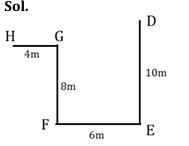
Hence, H is to the South-West of D.